
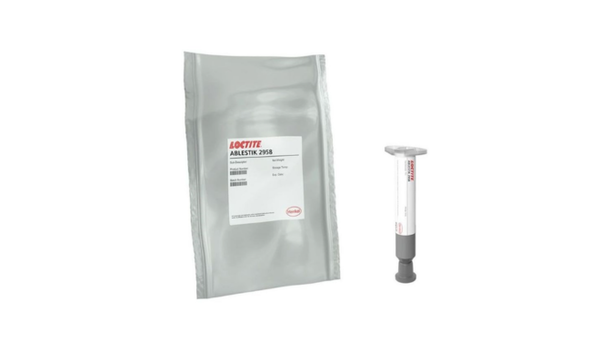
ABLESTIK 2958
Harmonization Code : 3506.91.90.99 | Prepared glues and other prepared adhesives, not elsewhere specified or included; products suitable for use as glues or adhesives, put up for retail sale as glues or adhesives, not exceeding a net weight of 1 kg ; Adhesives based on polymers of headings 3901 to 3913 or on rubber; Other ; Other
Main features
- Electrically Conductive Bonding
- 40,000 mPa s Mixed Viscosity
- 15-Minute 100 deg C Cure
Product Description
LOCTITE ABLESTIK 2958 is a silver-filled, two-component epoxy adhesive for electrically conductive bonding and sealing in electronic and microelectronic assemblies. The 100% reactive-solids system mixes at 100:6 resin-to-hardener by weight and forms a smooth, screen-printable paste with a typical mixed viscosity of 40,000 mPa.s (cP) at 25 degC and a four-hour pot life. It supports snap-cure schedules as short as 2 minutes at 150 degC and is documented for chip bonding, electrical modules, printed circuitry, wave guides, high-frequency shields, and die-attach applications.
Key Features
- Silver-filled, electrically and thermally conductive epoxy adhesive
- Two-component, 100% reactive-solids formulation with no contaminating solvents or additives
- 100:6 resin-to-hardener mix ratio by weight
- Typical mixed viscosity of 40,000 mPa.s (cP) at 25 degC
- Four-hour pot life and thixotropic index of 2.9
- Heat-cure schedules from 15 minutes at 100 degC to 2 minutes at 150 degC
- Operating-temperature range of -60 to 175 degC
Applications / Suitable for
- Chip bonding and die-attach bonding
- Electrical modules and printed circuitry
- Wave guides and high-frequency shields
- Electronic and microelectronic bonding or sealing
TDS, SDS & Technical Documents
Technical Specifications
General Properties
Thermal Properties
Physical Properties
Additional Information
Electrically Conductive Electronics Adhesive
LOCTITE ABLESTIK 2958
LOCTITE ABLESTIK 2958 is a silver-filled, two-component epoxy adhesive for electrically conductive bonding and sealing in electronic, microelectronic, and die-attach applications. The smooth paste is screen printable, contains 100% reactive solids, and combines a four-hour pot life with snap-cure schedules down to 2 minutes at 150 degC.

Resin, Hardener and Mixed Paste
As-Supplied Properties
The system consists of silver-filled LOCTITE ABLESTIK 2958-R conductive epoxy resin and LOCTITE ABLESTIK 2958-H epoxy hardener. The TDS provides mixed-state process properties, while the current U.S. SDS documents component-specific physical state, color, and relative density.
| Material state | Property | Typical value | Condition / context |
|---|---|---|---|
| 2958-R resin | Physical state / color | Silver liquid paste | Conductive epoxy component |
| 2958-R resin | Relative density | 3.5 | Current U.S. SDS |
| 2958-H hardener | Physical state / color | Colorless to amber liquid | Epoxy hardener component |
| 2958-H hardener | Relative density | 1.0 | Current U.S. SDS |
| Mixed material | Mix ratio | 100 : 6 | Resin : hardener by weight |
| Mixed material | Viscosity | 40,000 mPa.s (cP) | 25 degC |
| Mixed material | Thixotropic index | 2.9 | 5 / 50 rpm |
| Mixed material | Specific gravity | 2.65 | Mixed system |
| Mixed material | Reactive solids content | 100% | Mixed system |
| Mixed material | Pot life | 4 hours | Supplier TDS value |
Storage and Handling
The TDS identifies 27 degC as the optimal storage temperature for unopened product in a dry location. Keep component containers closed and protect them from contamination. Material removed from a container should not be returned to the original container. The current U.S. resin SDS specifies a safe storage range of -20 to 50 degC, while the hardener SDS requires cool, well-ventilated storage away from incompatible materials and heat or ignition sources.
Final Conductive Bondline
Cured Properties
The cured epoxy provides both electrical and thermal conductivity. Bulk properties are presented separately from bonded-joint strength because conductivity, resistance, and mechanical performance remain dependent on cure, geometry, interfaces, and the tested configuration.
Typical cured bulk-material value.
Typical value after 5 minutes at 125 degC.
Documented product operating-temperature range.
| Property | Typical result | Condition / context |
|---|---|---|
| Coefficient of thermal expansion | 4.9 x 10^-5 cm/cm/degC | Typical cured value |
| Glass transition temperature | 92 degC | Typical cured value |
| Thermal conductivity | 1.50 W/(m-K) | Typical cured bulk value |
| Hardness | 80 Shore D | Typical cured value |
| Volume resistivity | 0.0005 ohm-cm | After 2 minutes at 150 degC |
| Volume resistivity | 0.0003 ohm-cm | After 5 minutes at 125 degC |
| Aluminum lap shear strength | 7 N/mm2 (1,000 psi) | Aged / cured at 150 degC for 2 minutes |
| Aluminum lap shear strength | 7 N/mm2 (1,000 psi) | Aged / cured at 125 degC for 5 minutes |
Documented Electronics Assembly Uses
Applications
Chip and Die Attach
The supplier positions ABLESTIK 2958 for chip bonding and die-attach bonding where an electrically conductive cured epoxy path is required. Final fit depends on die, metallization, bondline, cure, and package design.
Electrical Modules and Printed Circuitry
The screen-printable conductive paste is documented for electrical modules and printed circuitry, supporting evaluation where adhesive bonding and electrical conduction are combined.
Wave Guides and High-Frequency Shields
The TDS lists wave guides and high-frequency shields among typical assembly applications. Electrical performance remains dependent on the actual joint geometry, interfaces, and cured condition.
Technical Support for LOCTITE ABLESTIK 2958
Discuss mix-ratio control, pot life, screen printing or other deposition, cure profiling, bondline design, electrical interconnection, and die-attach evaluation with Krayden. Process trials should confirm performance in the intended component, substrate, metallization, joint geometry, cure, and operating environment.
Contact Krayden Technical Support


