
ABLESTIK 60L
Harmonization Code : 3506.91.90.99 | Prepared glues and other prepared adhesives, not elsewhere specified or included; products suitable for use as glues or adhesives, put up for retail sale as glues or adhesives, not exceeding a net weight of 1 kg ; Adhesives based on polymers of headings 3901 to 3913 or on rubber; Other ; Other
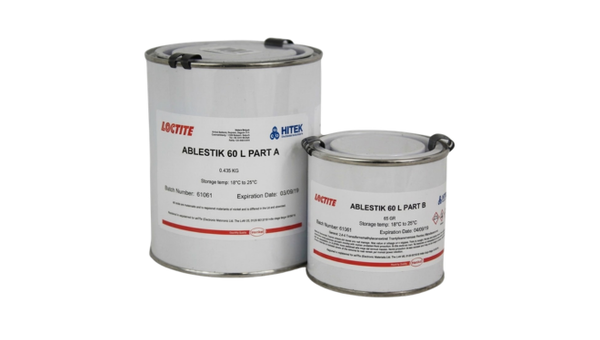
Main features
- 50 ohm-cm Volume Resistivity
- 30-Minute 25 deg C Cure
- 55 to 130 deg C Service Range
Product Description
LOCTITE ABLESTIK 60L Parts AB is a black, carbon-filled, two-component epoxy adhesive for electrically conductive general-purpose bonding. The resin and amine hardener are mixed at 100:15 by weight and provide a typical one-hour work life at 25 degC for a 100 g mass. The adhesive can be cured at room temperature or with heat and is documented for an operating-temperature range of -55 to 130 degC. Its cured properties include 1.2 W/(m-K) thermal conductivity and 50 ohm-cm volume resistivity at 25 degC.
Key Features
- Carbon-filled electrically conductive epoxy adhesive
- Two-component resin and amine hardener system
- 100:15 resin-to-hardener mix ratio by weight
- Typical one-hour work life at 25 degC for a 100 g mixed mass
- Room-temperature or heat-cure capability
- Operating-temperature range of -55 to 130 degC
- Typical cured thermal conductivity of 1.2 W/(m-K)
Applications / Suitable for
- General-purpose electrically conductive bonding
- Bonding applications where low electrical conductivity is acceptable
- Assemblies requiring conductive adhesive bonding across a variety of substrates
- Applications that do not require precise resistive properties for electrostatic-discharge control
TDS, SDS & Technical Documents
Technical Specifications
General Properties
Thermal Properties
Electrical Properties
Additional Information
Carbon-Filled Electrically Conductive Epoxy Adhesive
LOCTITE ABLESTIK 60L Parts AB
LOCTITE ABLESTIK 60L Parts AB is a black, carbon-filled, two-component epoxy adhesive designed for general-purpose electrically conductive bonding. It uses an amine hardener at a 100:15 resin-to-hardener ratio by weight, provides a typical one-hour work life at 25 degC for a 100 g mass, and can be cured at room temperature or with heat.
Component and Mixed Material Data
As-Supplied Properties
Part A is the epoxy resin and Part B is an amine hardener. Both are black pastes. Component-specific density and shelf-life values are kept separate from the mixed-material density and work life.
| Material state | Property | Typical value | Condition / method |
|---|---|---|---|
| Part A — resin | Appearance | Black paste | As supplied |
| Part A — resin | Density | 1.46 g/cm3 | ASTM D792 |
| Part A — resin | Shelf life | 274 days | 25 degC, from date of manufacture |
| Part B — hardener | Appearance | Black paste | Amine hardener |
| Part B — hardener | Density | 1.35 g/cm3 | ASTM D792 |
| Part B — hardener | Shelf life | 274 days | 25 degC, from date of manufacture |
| Mixed material | Density | 1.46 g/cm3 | ASTM D792 |
| Mixed material | Work life | 1 hour | 100 g mass at 25 degC |
Preparation, Mixing and Cure
Mixing and Cure
Clean substrates thoroughly to remove oxide layers, dust, moisture, salt, oils, and other contamination. Because component separation can occur during shipping and storage, remix each shipping container thoroughly before measuring. Accurately weigh resin and hardener at 100:15 by weight, then blend for 2 to 3 minutes using a kneading motion while scraping the sides and bottom of the mixing container.
Cure profiles are guideline recommendations and may require adjustment for the application, equipment, oven loading, and actual material temperature.
Storage and Handling
The TDS specifies a maximum storage temperature of 25 degC for the unopened product in a dry location, with a typical shelf life of 274 days at 25 degC for both Part A and Part B. Keep containers closed and do not return removed material to the original container. The supplied U.S. Part B SDS likewise specifies storage at or below 25 degC and avoidance of moisture.
Final Cured Adhesive
Cured Properties
The cured adhesive provides a carbon-filled conductive path with moderate bulk thermal conductivity and documented mechanical strength. The values below are typical laboratory results and should not be treated as guaranteed system-level performance.
ASTM D2214.
ASTM D257 at 25 degC.
Documented product operating-temperature range.
| Property | Typical result | Method / condition |
|---|---|---|
| Thermal conductivity | 1.2 W/(m-K) | ASTM D2214 |
| Flexural strength | 41 N/mm2 (6,000 psi) | ASTM D1184 |
| Volume resistivity | 50 ohm-cm | ASTM D257, 25 degC |
| Tensile lap shear strength | 10.4 N/mm2 (1,500 psi) | ASTM D1002, aluminum-to-aluminum at 25 degC |
Documented Use Scope
Applications
General Conductive Bonding
Designed for general-purpose bonding where an electrically conductive carbon-filled epoxy is appropriate.
Broad Substrate Bonding
The manufacturer states that the material adheres well to a variety of substrates. Exact material compatibility should be confirmed for the intended surface, finish, preparation, and service environment.
Non-Precision Resistive Applications
The TDS explicitly states that the product is not intended where precise resistive properties, such as electrostatic-discharge control, are required.
Technical Support for LOCTITE ABLESTIK 60L Parts AB
Discuss component handling, mix-ratio control, working time, substrate preparation, cure profiling, conductive-joint requirements, and application validation with Krayden. Trials should confirm adhesion, electrical behavior, thermal performance, and mechanical strength in the intended assembly.
Contact Krayden Technical Support


