
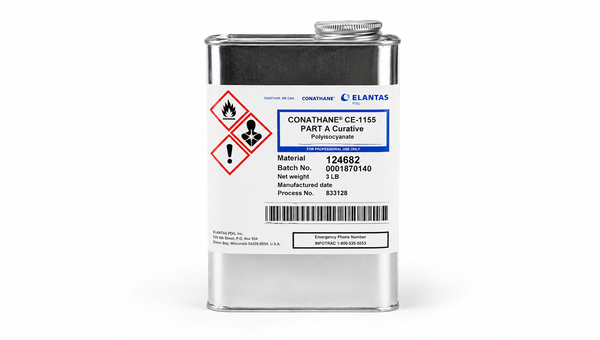
CONATHANE CE-1155
Harmonization Code : 3404.90.00.00 | Artificial waxes and prepared waxes : Other
Main features
- Two-Component Polyurethane Conformal Coating
- Six-Hour Working Window
- Spray, Dip, or Brush Application
Product Description
CONATHANE CE-1155 is a two-component, solvent-based polyurethane conformal coating for printed circuit boards and electronic assemblies. The system can be applied by spray, dip, or brush. It mixes at 100:70 by weight, has a documented 6-hour pot life for a 400 g mass at 25 deg C, and includes a fluorescent dye to support ultraviolet inspection of the applied film. Documented applications include printed circuit boards, microelectronics, and controller units and electrical devices.
Key features
- Material system: Two-component solvent-based polyurethane conformal coating for printed circuit boards and electronic assemblies.
- Mix ratio: 100:70 by-weight mix ratio with 72 cP initial mixed viscosity and 6-hour pot life at 25 deg C.
- Processing window: Spray, dip, or brush application with documented room-temperature and elevated-temperature cure schedules.
Applications
- Printed circuit boards
- Microelectronics
- Controller units and electrical devices
TDS, SDS & Technical Documents
Technical Specifications
General Properties
Physical Properties
Electrical Properties
Additional Information
Conformal Coatings
Two-component polyurethane coating for electronic assemblies
CONATHANE CE-1155 is a two-component, solvent-based polyurethane conformal coating for printed circuit boards and electronic assemblies. The system can be applied by spray, dip, or brush. It mixes at 100:70 by weight, has a documented 6-hour pot life for a 400 g mass at 25 deg C, and includes a fluorescent dye to support ultraviolet inspection of the applied film.
As supplied
Typical Part A and Part B properties
Component properties are separated from mixed and cured coating data.
| Property | Part A | Part B |
|---|---|---|
| Color | Clear amber | Clear amber |
| Brookfield viscosity at 25 deg C | 300 cP | 70 cP |
| Specific gravity at 25 deg C | 1.13 | 0.96 |
| Solids content | 60% | 64-66% |
| NCO content | 10.2-10.7% | Not reported |
| Flash point, Seta Flash | 81 F | 45 F |
| Shelf life at 25 deg C | 15 months | 15 months |
Processing
Mix, adjust viscosity if required, coat, and cure
CE-1155 uses a 100:70 Part A/Part B weight ratio with time-dependent mixed viscosity, defined film-build limits, recoating intervals, and cure schedules.
- Mix Part A and Part B thoroughly at 100:70 by weight. Air bubbles introduced during mixing are stated to dissipate in a few minutes.
- At 25 deg C, typical Brookfield mixed viscosity is 72 cP initially, 92 cP after 1 hour, 172 cP after 3 hours, and 432 cP after 6 hours.
- Apply by spray, dip, or brush. CONAP S-8 solvent may be used to reduce viscosity or adjust film thickness; 10-20% dilution is recommended for most applications.
- Limit one wet-film application to 2-2.5 mil to reduce the possibility of solvent entrapment. For multiple coats, allow 2 hours at room temperature or 30 minutes at 60 deg C before recoating.
- Documented cure schedules are 5-7 days at 25 deg C, 3 hours at 60 deg C, or 1 hour at 100 deg C, with corresponding tack-free times of 4-5 hours, 30-45 minutes, and 10-15 minutes.
Storage and handling
Maintain sealed storage and protect Part A from low-temperature crystallization
Store CE-1155 at 65-85 F (approximately 18-29 deg C) in tightly closed containers. If a container is partially used, flush it with dry nitrogen or dry air before resealing.
Shelf life is 15 months from date of manufacture in the original unopened containers under the recommended storage conditions.
If Part A crystallizes after low-temperature exposure, heat the container for 2-4 hours at 50-60 deg C until clear, then cool to room temperature before use.
Cured coating
Typical cured film and electrical properties
These values describe the cured CE-1155 film under the stated test conditions.
| Property | Typical value | Condition / method |
|---|---|---|
| Color | Clear | Cured film |
| Sward rocker hardness | 70 | Cured film |
| Pencil hardness | HB | Cured film |
| Dielectric constant | 3.50 / 3.43 / 3.21 | 25 deg C at 100 Hz / 1 kHz / 1 MHz |
| Dissipation factor | 0.0142 / 0.0138 / 0.0162 | 25 deg C at 100 Hz / 1 kHz / 1 MHz |
| Volume resistivity | 1.18 x 10^16 ohm-cm | 25 deg C |
| Surface resistivity | 5.66 x 10^14 ohm | 25 deg C |
| Dielectric strength | 3000 V/mil / 1045 V/mil | 0.002 in film / 0.022 in film |
Performance evidence
Insulation resistance during humidity cycling
For a 1.5-2.0 mil film, insulation resistance was recorded through ten humidity cycles. Adhesion to epoxy-glass panels was maintained during the test, and no under-film corrosion of the copper conductors was observed.
| Condition | Insulation resistance |
|---|---|
| Initial, 25 deg C / 50% RH | >2.5 x 10^13 ohm |
| 1st cycle, 65 deg C / 95% RH | 3.7 x 10^11 ohm |
| 4th cycle, 65 deg C / 95% RH | 1.4 x 10^11 ohm |
| 7th cycle, 65 deg C / 95% RH | 8.8 x 10^10 ohm |
| 10th cycle, 65 deg C / 95% RH | 6.1 x 10^10 ohm |
| 24 h after 10th cycle, 25 deg C / 50% RH | 6.0 x 10^12 ohm |
Dataset applies to the stated film thickness and humidity-cycle conditions.
Applications
Supported applications
Use the documented application scope below as the starting point for product evaluation.
Printed circuit boards
Conformal coating of printed circuit boards by spray, dip, or brush within the documented film-build and cure process.
Microelectronics
Microelectronics coating applications identified for CE-1155 in the supplied ELANTAS product selection material.
Controller units and electrical devices
Controller-unit and electrical-device coating applications identified for CE-1155 in the supplied ELANTAS selection material.
Technical support for CONATHANE CE-1155
Need help evaluating CE-1155 for a printed circuit board, coating method, wet-film build, recoating interval, or cure schedule? Krayden can help review the assembly geometry, application process, film-thickness target, inspection approach, and electrical or environmental test requirements before the coating is evaluated on the intended hardware.


