
COOLTHERM EP-636
Harmonization Code : 3910.00.00.90 | Silicones in Primary Forms; Others
Main features
- 205 deg C Staged-Cure Encapsulation
- 18.3 kV/mm Dielectric Strength
- 50,000 cP Mixed Viscosity
Product Description
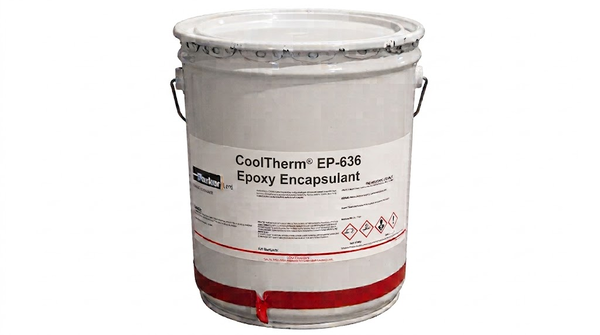
CoolTherm® EP-636 Epoxy Encapsulant is a two-component, ultra-high-temperature epoxy system for encapsulating electric motor stator assemblies used in downhole oil pumps and other harsh-environment electrical applications. The white resin and black hardener mix at a standard 100:1 ratio by weight to form a grey material with a typical 50,000 cP viscosity at 25°C, 30-minute gel time at 93°C, and one-to-two-day working life at 25°C. The documented cure is 16–24 hours at 50–65°C, followed by two hours each at 95°C, 150°C, and 205°C. Typical cured properties include 0.7 W/m·K thermal conductivity, 180°C glass transition temperature, 95 Shore D hardness, and 18.3 kV/mm dielectric strength.
Key features
- Ultra-high-temperature epoxy encapsulation system
- High-temperature electrical-insulation positioning for harsh environments
- Standard 100:1 resin-to-hardener ratio by weight
- Typical mixed viscosity of 50,000 cP at 25°C
- Long one-to-two-day working life at 25°C
- Staged cure through 205°C for final high-temperature properties
- Typical 180°C Tg, 35 ppm/°C CTE, and 18.3 kV/mm dielectric strength
Applications
- Electric motor stator assemblies used in downhole oil pumps
- High-temperature electrical and electronic encapsulation
- Large-mass castings requiring validated ratio, void control, and staged cure
TDS, SDS & Technical Documents
Technical Specifications
General Properties
Physical Properties
Electrical Properties
Thermal Properties
Additional Information
CoolTherm® EP-636 Epoxy Encapsulant
A two-component epoxy system designed for high-temperature electrical encapsulation, including motor stator assemblies used in downhole oil pumps. The system combines long working time, controlled viscosity, vacuum-compatible processing, and a staged cure that develops a rigid, high-Tg electrical-insulation material.
.png)
Component and mixed-material properties
The white resin and black hardener form a grey mixed encapsulant. Values below are typical and are not specification limits.
| Property | EP-636 resin | EP-636 hardener | Mixed material |
|---|---|---|---|
| Appearance | White liquid | Black liquid | Grey liquid |
| Viscosity at 25°C | 86,000 cP | 3,500 cP | 50,000 cP |
| Specific gravity at 25°C | 1.61 | 1.00 | 1.58 |
| Gel time at 93°C | 30 minutes | ||
| Working life at 25°C | 1–2 days | ||
Premix both components, meter the ratio, minimise voids, dispense, and complete the staged cure
Thoroughly mix each component separately, then combine 100 parts EP-636 resin with 1 part EP-636 hardener by weight until the colour is uniform. Automatic meter/mix/dispense equipment may be used for high-volume production.
- Large-mass castings may require 100:0.75 by weight; determine the optimal ratio by testing before production use.
- Use closed-chamber mixing where possible, or vacuum processing for high-voltage and other critical applications where void minimisation is important.
- Apply using handheld cartridges or automatic meter/mix/dispense equipment.
- Cure for 16–24 hours at 50–65°C, then two hours each at 95°C, 150°C, and 205°C.
- Alternate cure cycles require consultation with Parker LORD.
.png)
Restore both resin and hardener to a uniform state before metering.
Use 100:1 by weight unless a validated large-mass process uses 100:0.75.
Use closed-chamber mixing or vacuum where electrical or reliability requirements justify it.
Complete the initial 50–65°C hold and all three two-hour high-temperature stages.
Storage and handling
The resin has a one-year shelf life and the hardener has a two-year shelf life when stored at 25°C in their original unopened containers. Periodically rotate the resin container because settling will occur. If hardener crystals appear after storage or shipment, gently warm the hardener to 50–65°C until the crystals melt before mixing. Review the current regional SDS and product labels before use.
Thermal, mechanical, and electrical properties
These typical values are tied to the full documented cure of 24 hours at 65°C plus two hours each at 95°C, 150°C, and 205°C. Do not assume equivalent final properties from the initial low-temperature stage alone.
| Property | Typical value | Context |
|---|---|---|
| Thermal conductivity | 0.7 W/m·K | Bulk cured-material property. |
| Coefficient of linear thermal expansion | 35 ppm/°C | Typical bulk cured value. |
| Glass transition temperature by TMA | 180°C | Tested after the full staged cure. |
| Hardness | 95 Shore D | Rigid cured epoxy. |
| Tensile strength | 42.75 MPa (6,200 psi) | ASTM D638 bulk tensile property. |
| Volume resistivity at 25°C | 5.6 × 10¹⁵ ohm-cm | ASTM D257. |
| Dielectric strength | 18.3 kV/mm (464 V/mil) | ASTM D149; not a finished-system working-voltage rating. |
| Dielectric constant | 3.62 at 1 MHz and 25°C | ASTM D150. |
| Dissipation factor | 0.023 at 1 MHz and 25°C | ASTM D150. |
High-temperature stator and electrical encapsulation
The directly supported application is encapsulation of electric motor stator assemblies used on downhole oil pumps. Broader high-temperature electrical use requires validation of voltage, section size, cure uniformity, thermal cycling, fluids, pressure, and the complete operating environment.
.png)
.png)
.png)
Potting & Encapsulation Materials Catalogue — PC3002
The catalogue identifies EP-636 as a grey, two-component, thermally conductive, ultra-high-temperature epoxy encapsulant with 50,000 cP viscosity, a 100:1 mix ratio, 95 Shore D hardness, 18.3 kV/mm dielectric strength, and 0.7 W/m·K conductivity.
Use the current technical datasheet for processing and property details. The catalogue is intended for portfolio comparison.
Validate EP-636 for your high-temperature encapsulation process
Krayden can help review batch size, large-mass ratio evaluation, mixing, vacuum processing, dispensing, staged cure, void control, electrical insulation, Tg, CTE, and environmental qualification for CoolTherm® EP-636.


