
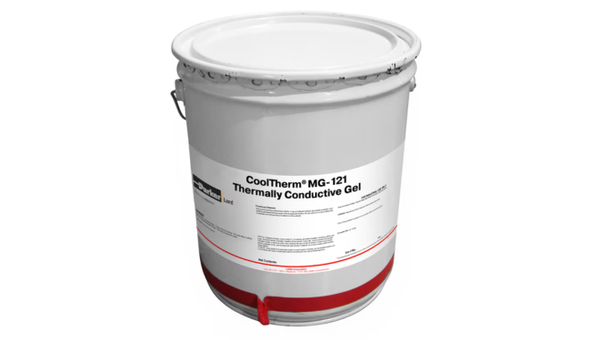
COOLTHERM MG-121
Harmonization Code : 3506.10.00.00 | Prepared glues and other prepared adhesives, not elsewhere specified or included; products suitable for use as glues or adhesives, put up for retail sale as glues or adhesives, not exceeding a net weight of 1 kg
Main features
- 2.3 W/(m K) Thermal Conductivity
- Low-Modulus Cured Bonding
- Eight-Hour Working Window
Product Description
CoolTherm® MG-121 Thermally Conductive Gel is a one-component silicone thermal interface material for transferring heat from flip-chip microprocessors, PPGAs, BGAs, microBGAs, DSPs, graphics accelerator chips, and other high-wattage electronic components. The grey paste has a typical viscosity of 60,500 cP at 20 rpm or 75,000 cP at 10 rpm at 25°C, an eight-hour working life at 25°C, and an eight-minute gel time at 100°C. It is formulated for 1–2 mil thin bondlines and to inhibit bleed, separation, and pump-out. Supported cure schedules are 2 hours at 100°C, 60 minutes at 125°C, or 30 minutes at 150°C. Typical cured properties include 2.3 W/m·K thermal conductivity, 30,000 Pa storage modulus at 25°C, -121°C Tg, and 8 × 10¹³ ohm-cm volume resistivity.
Key features
- One-component silicone gel for high-wattage semiconductor thermal interfaces
- Designed for 1–2 mil thin bondlines
- 2.3 W/m·K typical thermal conductivity
- Formulated to inhibit bleed, separation, and pump-out
- Low 30,000 Pa storage modulus at 25°C and -121°C Tg
- Positioned for HAST, moisture, and temperature-cycling resistance
- UL 94 V-0 certified, subject to the current listed formulation and test construction
Applications
- Flip-chip microprocessors
- PGA, BGA, and microBGA packages
- DSP and graphics accelerator chips
- Other high-wattage electronic components requiring a cured, compliant thermal interface
TDS, SDS & Technical Documents
Technical Specifications
General Properties
Physical Properties
Thermal Properties
Electrical Properties
Additional Information
CoolTherm® MG-121 Thermally Conductive Gel
A one-component silicone interface material engineered to transfer heat from flip-chip microprocessors and other high-wattage semiconductor packages. MG-121 is formulated for thin 1–2 mil bondlines, good wetting, low cured modulus, and resistance positioning against bleed, separation, pump-out, moisture, and temperature cycling.
.png)
Frozen, syringe-dispensable gel properties
MG-121 is supplied as a grey paste. The datasheet reports two viscosity values at different rotational speeds, so the speed condition remains attached to each result.
| Property | Typical value | Context |
|---|---|---|
| Appearance | Grey paste | One-component silicone thermal gel. |
| Viscosity at 25°C, 20 rpm | 60,500 cP | Speed-specific TDS value. |
| Viscosity at 25°C, 10 rpm | 75,000 cP | Speed-specific TDS value. |
| Specific gravity | 2.56 | Consistent with the current SDS density of 2.56 g/cm³. |
| Gel time at 100°C | 8 minutes | Gel time is not equivalent to the full cure schedule. |
| Working life at 25°C | 8 hours | Ambient process window after thawing and conditioning. |
Thaw upright, dry and purge the syringe, dispense the controlled interface, and heat cure
Warm the frozen syringe naturally to room temperature, ideally 20–25°C, while keeping it vertical with the dispense tip facing downward. Do not use ovens, hot plates, hot-air guns, warm water, or other artificial heat sources to accelerate thawing.
- Typical thaw time from -30°C to 25°C is 75 minutes for a 3–10 cc syringe, 1.5 hours for a 30–55 cc syringe, and two hours for a six-ounce cartridge.
- Remove surface moisture before use and manually purge normal tip-area air.
- Mount the syringe on thoroughly cleaned dispensing equipment and purge until the flow is unbroken.
- Control dispense volume, coverage, pressure, bondline stops, assembly force, and final 1–2 mil bondline through the validated part design.
- Cure for two hours at 100°C, 60 minutes at 125°C, or 30 minutes at 150°C.
- Count cure time after the gel reaches the target temperature and account for oven ramp and assembly thermal mass.
.png)
Allow the frozen syringe to reach 20–25°C naturally with the tip facing down.
Remove condensation and purge syringe-tip air and the dispensing path.
Apply the validated pattern and compress to the controlled 1–2 mil bondline.
Use the 100°C, 125°C, or 150°C time-at-temperature schedule.
Frozen storage and industrial handling
Shelf life is six months when stored at -30°C in the original unopened container. Store syringes vertically with the dispense tip facing downward and do not store them horizontally. The material crystallises at -40°C, so avoid storage at -40°C or below. The current US SDS is effective 1 November 2024 and identifies inhalation, reproductive, and aquatic hazards. It also notes that methylpolysiloxanes may generate formaldehyde at approximately 150°C and above in oxygen-containing atmospheres. Use trained industrial personnel, adequate ventilation, suitable gloves and eye protection, environmental controls, and the current regional SDS and label.
Thermal, mechanical, expansion, and electrical properties
The following values are typical cured-material properties. Thermal conductivity does not by itself define installed thermal resistance; the final interface also depends on bondline thickness, contact quality, area, pressure, flatness, cure, and adjacent surfaces.
| Property | Typical value | Context |
|---|---|---|
| Thermal conductivity | 2.3 W/m·K | Hot Disc Transient Method, ISO 22007-2. |
| Coefficient of linear thermal expansion | 232 ppm/°C α2 | Only the α2 value is published in DS3661. |
| Glass transition temperature | -121°C | By TMA. |
| Storage modulus at 25°C | 30,000 Pa | Low-modulus cured gel property. |
| Volume resistivity at 25°C | 8 × 10¹³ ohm-cm | Bulk electrical property; not an assembly working-voltage rating. |
Thin-bondline thermal coupling for high-wattage semiconductor packages
MG-121 is directly positioned for transferring heat from flip-chip microprocessors, PPGAs, BGAs, microBGAs, DSP chips, graphics accelerator chips, and other high-wattage components. Selection requires validation of the actual heat load, area, bondline, clamping or assembly force, surface flatness, material coverage, cure, electrical clearances, rework method, and environmental profile.
.png)
.png)
.png)
Microelectronic Materials Catalogue — PC3003
The catalogue lists MG-121 as a one-component thermally conductive gel with 60,500 cP viscosity, the three supported cure schedules, 2.3 W/m·K conductivity, 8 × 10¹³ ohm-cm resistivity, -121°C Tg, and bleed, separation, pump-out, and HAST-resistance positioning.
Open the Microelectronic Materials CatalogueElectronic Materials Handling — -30°C Storage
UI3027 provides frozen-storage orientation, insulated-glove guidance, FIFO handling, ambient thawing, package-specific thaw times, condensation removal, and tip-purging instructions.
Open the -30°C handling instructionsElectronic Materials for LED Applications — SG1013
The LED selector guide includes MG-121 in its thermal-material comparison table with silicone chemistry, UL 94 V-0, 60,500 cP viscosity, 2.3 W/m·K conductivity, six-month shelf life at -30°C, eight-hour working life, and the documented cure schedules.
Open the LED Materials Selector GuideValidate MG-121 for your semiconductor thermal interface
Krayden can help review heat load, interface area, 1–2 mil bondline control, dispense pattern, frozen handling, assembly pressure, surface flatness, cure profile, HAST and thermal-cycling requirements, rework, UL scope, and assembly-level thermal resistance for CoolTherm® MG-121.


