
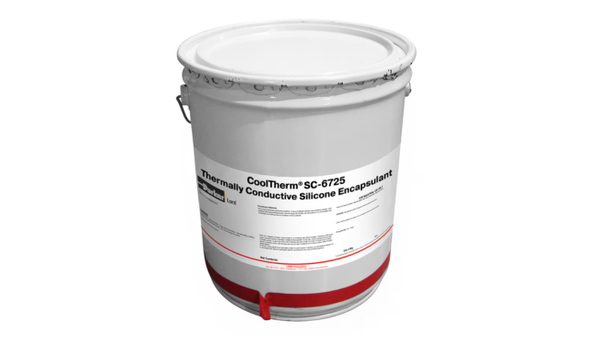
COOLTHERM SC-6725
Harmonization Code : 3910.00.00.90 | Silicones in Primary Forms; Others
Main features
- 1.16 W/(m K) Thermal Encapsulation
- 15,000 cP Mixed Viscosity
- Primerless Encapsulation Processing
Product Description
CoolTherm® SC-6725 Thermally Conductive Silicone Encapsulant is a two-component, addition-cure silicone system developed for electronic encapsulation where high-temperature service is required. The red resin and white hardener mix at a simple 1:1 ratio by weight or volume to form a red liquid with a typical 15,000 cP viscosity at 25°C and four-hour working life at 25°C. The documented cure is four hours at 85°C, with an overnight post-cure at 85°C recommended for optimum properties, particularly in large-volume applications. The cured red elastomer provides typical 1.16 W/m·K thermal conductivity, 45 Shore A hardness, 1 × 10¹⁴ ohm-cm volume resistivity, and a documented operating-temperature range of -55°C to 260°C.
Key features
- Two-component thermally conductive addition-cure silicone encapsulant
- Simple 1:1 mix ratio by weight or volume
- 15,000 cP mixed viscosity and four-hour working life
- Primerless-adhesion positioning on most substrates, subject to validation
- Typical 1.16 W/m·K thermal conductivity
- Reversion-resistant high-temperature silicone positioning
- Documented material-use range from -55°C to 260°C
Applications
- Thermally conductive encapsulation for high-temperature electronic assemblies
- Modules requiring flexible silicone insulation and heat transfer
- Large-volume encapsulation using a validated 85°C cure and post-cure process
- Assemblies requiring evaluated primerless adhesion to compatible substrates
TDS, SDS & Technical Documents
Technical Specifications
General Properties
Physical Properties
Thermal Properties
Electrical Properties
Mechanical Properties
Additional Information
CoolTherm® SC-6725 Thermally Conductive Silicone Encapsulant
A two-component silicone system developed for thermally conductive encapsulation where high-temperature service, flexible electrical insulation, and resistance to high-temperature reversion are important. SC-6725 cures to a red elastomer and is positioned to adhere to most substrates without primer, subject to surface and process validation.
.png)
Component and mixed-material properties
Thoroughly premix both components before combining them. The resin and hardener support equal-ratio metering by weight or volume.
| Property | SC-6725 resin | SC-6725 hardener | Mixed material |
|---|---|---|---|
| Appearance | Red liquid | White liquid | Red liquid |
| Viscosity at 25°C | 14,000 cP | 16,000 cP | 15,000 cP |
| Specific gravity | 1.90 | 1.80 | 1.80 |
| Mix ratio | 1:1 by weight or volume | ||
| Working life at 25°C | 4 hours | ||
Premix both components, meter 1:1, dispense automatically, and cure at 85°C
- Thoroughly mix the resin and hardener separately before combining them.
- Meter at 1:1 by weight or volume and mix to a uniform red condition.
- Apply using automatic meter/mix/dispense equipment.
- Avoid surfaces containing cure-inhibiting amines, sulphur, or tin salts.
- Use a test patch when substrate compatibility is uncertain.
- Cure for four hours at 85°C after the material reaches the target temperature.
- Account for oven ramp and part thermal mass; an overnight post-cure at 85°C is recommended for optimum properties, especially with large volumes.
.png)
Storage and industrial handling
Each component has a six-month shelf life from manufacture when stored at 25°C in its original unopened container. The current US resin SDS is effective 1 December 2021 and classifies the resin as harmful to aquatic life. The current hardener SDS is effective 31 October 2024 and classifies the hardener for suspected reproductive toxicity and acute and chronic aquatic hazards. Both SDS documents warn that methylpolysiloxanes may generate formaldehyde at approximately 150°C and above in oxygen-containing atmospheres. Use trained industrial personnel, adequate ventilation, appropriate personal protection, environmental controls, and the current regional SDS documents and labels.
Thermal, mechanical, and electrical properties
The following values are typical cured-material results rather than lot specifications. Installed thermal performance and electrical design limits depend on encapsulant geometry, voids, cure, interfaces, voltage, and the finished assembly.
| Property | Typical value | Context |
|---|---|---|
| Thermal conductivity | 1.16 W/m·K | Bulk cured-material property. |
| Hardness | 45 Shore A | Flexible cured red elastomer. |
| Tensile strength | 550 psi | Test method is not stated in DS3577. |
| Elongation at break | 80% | Typical cured-material value. |
| Volume resistivity at 25°C | 1 × 10¹⁴ ohm-cm | ASTM D257; not a finished-assembly working-voltage rating. |
High-temperature thermal encapsulation with primerless-adhesion positioning
SC-6725 is directly positioned for high-temperature electronic encapsulation. Final qualification must consider substrate chemistry, cure inhibition, component layout, fill depth, large-volume cure, post-cure, thermal path, voltage, void tolerance, operating-temperature profile, reversion exposure, corrosion risk, and repairability.
.png)
.png)
.png)
Potting & Encapsulation Materials Catalogue — PC3002
PC3002 lists SC-6725 as a red, two-component, 1:1 silicone with 15,000 cP viscosity, four-hour cure at 85°C, 45 Shore A hardness, and 1.16 W/m·K thermal conductivity. It describes the product as a high-density, thermally conductive, primerless silicone.
Validate SC-6725 for your high-temperature encapsulation process
Krayden can help review 1:1 metering, component premixing, dispense equipment, substrate compatibility, cure inhibition, fill geometry, large-volume post-cure, thermal path, operating temperature, electrical design, and assembly-level qualification.


