
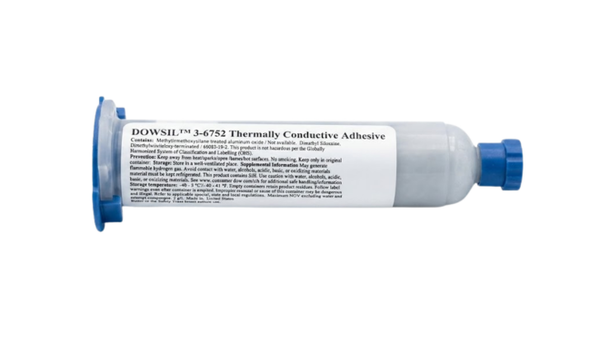
DOWSIL 3-6752
Harmonization Code : 3506.10.00.00 | Prepared glues and other prepared adhesives, not elsewhere specified or included; products suitable for use as glues or adhesives, put up for retail sale as glues or adhesives, not exceeding a net weight of 1 kg
Main features
- 1.8 W/(m K) Thermal Bonding
- 3-Minute Cure Cycle
- 3.8 MPa Aluminum Lap Shear
Product Description
DOWSIL™ 3-6752 Thermally Conductive Adhesive is a one-part, grey, heat-cure silicone adhesive designed to bond hybrid-circuit substrates, power-semiconductor components, and electronic devices to heat sinks. The thixotropic material becomes more flowable under dispensing shear while retaining placement after application. It has a typical 81,250 cP viscosity and supports cure schedules of 40 minutes at 100°C, 10 minutes at 125°C, or 3 minutes at 150°C. Typical cured properties include 1.7–1.8 W/m·K thermal conductivity, 87 Shore A hardness, approximately 3.7–3.8 MPa unprimed aluminium lap-shear adhesion, and 15.7 kV/mm dielectric strength.
Key features
- One-part thermally conductive silicone adhesive
- Thixotropic rheology for shear-assisted dispensing and placement control
- High 1.7–1.8 W/m·K typical thermal conductivity
- Fast heat cure in as little as three minutes at 150°C
- Primerless-adhesion positioning on selected metals, ceramics, filled plastics, epoxy laminates, and organic substrates
- No added solvents and no cure by-products
- UL 94 V-0 classification, subject to the current recognised formulation and test construction
Applications
- Bonding hybrid-circuit substrates to heat sinks
- Bonding power-semiconductor components and devices to heat sinks
- Electronic bonding applications requiring flexibility and thermal conductivity
- Automated dispensing of pre-formed thermal adhesive deposits
TDS, SDS & Technical Documents
Technical Specifications
General Properties
Mechanical Properties
Electrical Properties
Thermal Properties
Additional Information
DOWSIL™ 3-6752 Thermally Conductive Adhesive
A refrigerated, one-part silicone adhesive developed to create a bonded thermal path between hybrid-circuit substrates, power-semiconductor devices, electronic components, and heat sinks. Its thixotropic rheology increases flowability during dispensing while helping the deposited material retain position before heat cure.

Thixotropic, ready-to-dispense adhesive properties
The grey material is supplied as a single component. Its apparent viscosity changes under shear, so dispensing behaviour must be validated with the actual nozzle, pressure, temperature, and equipment.
| Property | Typical value | Context |
|---|---|---|
| Colour | Grey | One-part silicone adhesive. |
| Viscosity | 81,250 cP | Supplier-published typical value. |
| Thixotropy index | 3.8 | Indicates shear-dependent flow rather than a fixed dispense rate. |
| Shelf life | 6 months at 5°C | Store refrigerated in the original unopened container. |
Condition the refrigerated package, dispense the controlled deposit, assemble the joint, and heat cure
- Allow the sealed package to equilibrate under the supplier-approved conditions before opening to reduce condensation risk.
- Use clean dispensing equipment and validate nozzle diameter, pressure, speed, stand-off, deposit volume, and adhesive temperature.
- Control bondline thickness and component position through the joint design, spacers, stops, or fixtures.
- Assemble within the validated open process window and prevent movement during cure.
- Cure for 40 minutes at 100°C, 10 minutes at 125°C, or 3 minutes at 150°C.
- Count cure time after the adhesive reaches the selected temperature and account for oven ramp, heat-sink mass, and fixture thermal mass.
- Confirm adequate cure and cohesive adhesion on the actual substrates before production release.
.png)
Refrigerated storage and industrial handling
Store DOWSIL™ 3-6752 at 5°C in the original unopened container for the published six-month shelf life. Avoid repeated uncontrolled warming and cooling, contamination, moisture condensation, and prolonged exposure outside the validated handling window. No SDS was supplied in the product-resource list, so final publication and use require the current regional safety data sheet, container label, and applicable ventilation, personal protection, storage, spill, transport, and waste controls.
Thermal, mechanical, adhesion, and electrical properties
The values below are typical material or joint-test results rather than specifications. Installed thermal resistance and bond durability depend on bondline thickness, area, contact quality, surface preparation, cure, joint geometry, loading, and environmental exposure.
| Property | Typical value | Context |
|---|---|---|
| Specific gravity | 2.61 | Cured material. |
| Thermal conductivity | 1.7–1.8 W/m·K | Published sources vary slightly; confirm the approved current TDS value. |
| Hardness | 87 Shore A | Firm cured silicone adhesive. |
| Tensile strength | Approximately 3.76 MPa (545 psi) | Bulk-material result. |
| Elongation at break | 15% | Typical cured-material value. |
| Unprimed aluminium lap shear | Approximately 3.7–3.8 MPa (540–550 psi) | Aluminium joint result; not universal substrate strength. |
| Volume resistivity | Confirm current TDS value | A reliable value was not resolved from the supplied resource description. |
| Dielectric strength | 15.7 kV/mm (400 V/mil) | Breakdown property, not design working voltage. |
| Dissipation factor | 0.007 at 100 Hz; ≤0.00010 at 100 kHz | Frequency-specific values. |
| Service-temperature range | -45°C to 200°C | General material-use range, not a guaranteed service-life rating. |
Bond power devices and circuit substrates only after validating the complete joint
DOWSIL™ 3-6752 is directly positioned for bonding hybrid-circuit substrates, power-semiconductor components, and electronic devices to heat sinks. Supplier and distributor sources also identify adhesion positioning on metals, ceramics, filled plastics, epoxy laminates, and selected organic substrates. Each surface, cleaning process, bondline, cure, and load case requires testing.
.png)
.png)
.png)
Validate DOWSIL™ 3-6752 for your power-device bonding process
Krayden can help review refrigerated handling, dispense temperature, nozzle and pressure, thixotropic recovery, bondline thickness, fixturing, heat cure, substrate preparation, lap-shear validation, installed thermal resistance, and assembly qualification.


