DOWSIL DA6534

Harmonization Code : 3208.20.90 | Paints and varnishes that are dispersed or dissolved in a non aqueous medium
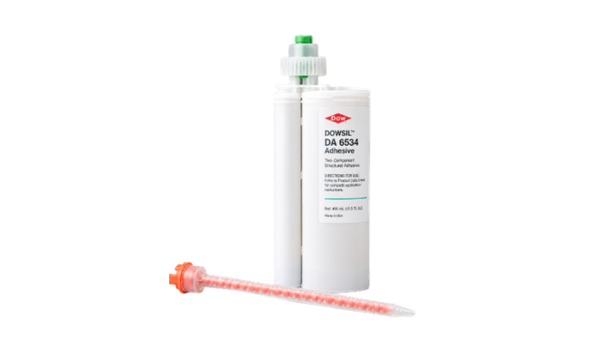
DOWSIL DA6534

Main features

  • 6.8 W/(m K) Thermal Conductivity
  • Electrically Conductive Bonding
  • One-Part Heat-Cure Bonding

Product Description

DOWSIL™ DA-6534 Adhesive is a one-part, silver-filled polydimethylsiloxane adhesive for microelectronics thermal interface bonding. The gray paste heat cures in 120 minutes at 150 °C and combines a typical thermal conductivity of 6.8 W/m·K with a typical volume resistivity of 1.8 × 10⁻⁴ Ω·cm. It has documented adhesion to nickel, aluminum, laminate, and silicon and is positioned for TIM1 and lid-seal applications. Low reported sodium, potassium, and chloride impurity levels support evaluation in electronics packaging processes requiring controlled thermal, electrical, and adhesive properties.

Key features

  • Thermal conductivity: 6.8 W/m·K typical cured-material value.
  • Electrical conductivity: 1.8 × 10⁻⁴ Ω·cm typical volume resistivity.
  • One-part heat cure: Gray paste; 120 minutes at 150 °C.

Applications / Suitable for

  • Microelectronics thermal interface bonding
  • TIM1 interfaces
  • Microelectronics lid-seal applications
Product Family

DOWSIL DA6534

Catalog Product

Unlike other products we offer, the products listed on this page cannot currently be ordered directly from the website.

TDS, SDS & Technical Documents

Technical Specifications

General Properties
ColorColor
Gray
Component SystemComponent System
One part
Specific GravitySpecific Gravity
4.4 (cured)
Physical Properties
Thixotropic indexThixotropic index
2
Thermal Properties
Thermal ConductivityThermal Conductivity
6.8 W/m.K

Additional Information

Conductive silicone adhesive

DOWSIL™ DA-6534 Adhesive

DOWSIL™ DA-6534 Adhesive is a one-part, silver-filled silicone adhesive for microelectronics thermal interface bonding. Its heat-cured material combines 6.8 W/m·K typical thermal conductivity with 1.8 × 10⁻⁴ Ω·cm typical volume resistivity, while documented adhesion to nickel, aluminum, laminate, and silicon supports evaluation for TIM1 and lid-seal assemblies.

One-part gray paste Silver-filled silicone 6.8 W/m·K thermal conductivity 1.8 × 10⁻⁴ Ω·cm volume resistivity 120 min at 150 °C Microelectronics grade
Approved product image of DOWSIL™ DA-6534 Adhesive packaging or supplied product form.


Material format

As-supplied properties

Component count
One part
No component mixing or mix-ratio control is required before application.
Viscosity
103,000 cP
Typical Cone and Plate Carrimed result for the gray paste as supplied.
Composition
PDMS + conductive filler
Silver-filled polydimethylsiloxane formulation for conductive adhesive use.
Application and cure

Processing DOWSIL™ DA-6534 Adhesive

Control surface preparation, syringe conditioning, dispensing, and heat cure when evaluating adhesion and interface performance. The product guidance emphasizes clean substrates, moisture protection, and compatibility screening for materials that may inhibit addition cure.

Surface preparation: Thoroughly clean or degrease substrates. Light abrasion may improve cleaning and bonding area; a final IPA wipe can remove residual contamination.
Syringe dispensing: For syringe packaging, condition the unopened bag at room temperature for at least one hour with the syringe on its side. The TDS identifies 10–30 psi air pressure or auger dispensing.
Heat cure: 120 minutes at 150 °C. Treat this as the documented cure schedule, not a universal cure profile for different bondline temperatures or assembly designs.

Recommended processing sequence

Stage 1
Prepare the substrates
Clean and degrease the bonding surfaces. Use light abrasion where appropriate, then complete the preparation with an IPA wipe when needed to remove residues.
Stage 2
Condition and dispense
Follow the product-label storage conditions. For syringe packaging, allow at least one hour at room temperature before opening the bag, remove the dust cap promptly, and remove the tip plug just before dispensing.
Stage 3
Assemble and heat cure
Apply the adhesive, assemble the interface, and cure for 120 minutes at 150 °C. Verify cure and bond performance with the actual substrate, surface condition, and assembly geometry.
Storage and Handling

Use the product by the “Use By” date on the label and store it at or below the maximum temperature specified for the package. Protect the material from moisture, keep containers tightly closed, minimize headspace, and purge partially filled containers with dry air or nitrogen. Follow all package-specific storage and handling instructions.

Adhesion and cure-control guidance

Verify the substrate and surface condition
Adhesion results depend on the substrate, preparation, and test configuration. Use lap-shear or similar testing on the intended materials. Cohesive failure can help confirm compatibility, establish a minimum cure time, and identify contaminants such as release agents, oils, grease, or oxide films.
Screen for addition-cure inhibition
Organotin compounds, sulfur-containing materials, unsaturated hydrocarbon plasticizers, and some solder flux residues can inhibit cure. Run a small-scale compatibility test when a material is questionable; liquid or uncured adhesive at the interface indicates incompatibility or cure inhibition.
Cured performance

Key cured properties

Thermal conductivity
6.8 W/m·K
Typical cured-material value; use bondline-specific testing for assembled-interface evaluation.
Volume resistivity
1.8 × 10⁻⁴ Ω·cm
Typical bulk value documenting the electrically conductive cured adhesive.
Unprimed lap shear on Al
194 psi (1.3 MPa)
Typical result for aluminum in the reported lap-shear configuration; not a universal joint-strength value.
Technical data

Typical cured-property data

Values are typical and are not intended for specification writing. Preserve the stated method, substrate, pressure, or material state when comparing data.

Property Value Unit Method / condition
Specific gravity 4.4 Cured material
Durometer 91 Shore A JIS
Thermal conductivity 6.8 W/m·K Typical cured-material value
Thermal resistance 0.12 °C·cm2/W At 40 psi
Unprimed lap-shear adhesion 194 / 1.3 / 134 psi / MPa / N/cm2 Aluminum substrate
Volume resistivity 1.8E-04 Ω·cm Typical cured-material value
Sodium ion impurity (Na+) 0.1 ppm Reported impurity level
Potassium ion impurity (K+) 0.2 ppm Reported impurity level
Chloride ion impurity (Cl-) 0.5 ppm Reported impurity level
Melt temperature (Tm) -45 °C DSC
Glass-transition temperature (Tg) -125 °C DSC
Linear coefficient of thermal expansion 125 ppm/°C TMA
Supported use contexts

Microelectronics thermal interface applications

Supported use contexts focus on microelectronics package interfaces that require a bonded, thermally conductive, and electrically conductive silicone material. Final suitability depends on the actual substrate, surface preparation, bondline, cure, and assembly design.

Illustration of a microelectronics package thermal interface bonded with DOWSIL™ DA-6534 Adhesive.
Microelectronics thermal interface bonding
The product is suitable for microelectronics thermal interface applications where the adhesive forms a bonded interface and contributes typical bulk thermal and electrical conductivity. Evaluate the actual package materials, bondline, pressure, cure, and thermal path.
Illustration of a TIM1 bondline between a semiconductor die and heat spreader using DOWSIL™ DA-6534 Adhesive.
TIM1 interfaces
TIM1 is specifically identified in the product literature. The 6.8 W/m·K typical thermal conductivity, 0.12 °C·cm²/W thermal resistance at 40 psi, and adhesive function are relevant to interface evaluation; assembled performance remains bondline- and design-dependent.
Illustration of a microelectronics lid-seal bondline using DOWSIL™ DA-6534 Adhesive.
Microelectronics lid sealing
Lid-seal applications are also identified for this grade. Documented adhesion to nickel, aluminum, laminate, and silicon, together with the one-part heat-cure process, supports evaluation for package-lid bonding on the intended substrate and surface condition.
Next steps

Discuss your DOWSIL™ DA-6534 evaluation with Krayden

Krayden can help review substrate combinations, surface preparation, syringe dispensing, cure conditions, and the thermal or electrical properties relevant to your TIM1 or lid-seal design. Contact our team to discuss samples, application fit, and a product-specific evaluation plan.

Leading Brands Trust in Our Products and Services

  • Jabil
  • Linxens
  • Magna
  • Medtronic
  • NXP
  • Philips
  • Semikron
  • Teledyne
  • Thales
  • Vishay
  • ZF
  • AMS
  • Apple
  • Audi
  • Broadcom
  • Borgwarner
  • Bosch
  • Eaton
  • Henkel
  • Honeywell
  • Hysol
  • Intel
Products that Perform|Knowledge that Serves|Service that Delivers