
DOWSIL EA-6060 Adhesive
Harmonization Code : 3506.91.90.99 | Prepared glues and other prepared adhesives, not elsewhere specified or included; products suitable for use as glues or adhesives, put up for retail sale as glues or adhesives, not exceeding a net weight of 1 kg ; Adhesives based on polymers of headings 3901 to 3913 or on rubber; Other ; Other
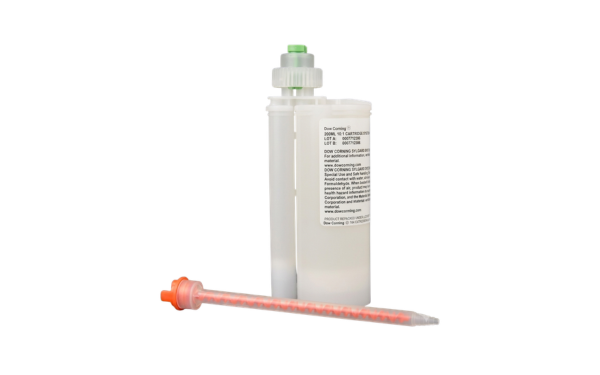
Main features
- Two-Part Adhesive System
- Moderate Adhesive Cure
- Broad Substrate Adhesion
Product Description
DOWSIL™ EA-6060 Adhesive is a two-part, non-flowing silicone adhesive designed to enable assembly production savings through a fast cure at moderate temperatures. It features an optimized adhesion package for lower temperature activity, curing and developing adhesion at 80°C within a maximum of 30 minutes. With the inclusion of a scavenger to reduce voids during cure and a UV dye for inspection, it provides high-quality, reliable bonds.
Product Key Features
- Two-Part System - features a convenient 1:1 mix ratio by weight or volume to simplify dispensing and mixing.
- Moderate Temperature Cure - heat-accelerated formula cures and achieves adhesion in 30 minutes at 80°C, 15 minutes at 90°C, or 10 minutes at 100°C.
- Void Reduction & Inspection - uses a scavenger to minimize voids during the curing process and includes a UV dye to aid in quality inspection.
- Robust Mechanical Profile - cures to deliver a tensile strength of 3.1 MPa, 290% elongation, and a dielectric strength of 18 kV/mm.
- Broad Adhesion - provides durable, unprimed lap shear adhesion to typical automotive substrates such as aluminum, PBT, and PA 66.
Applications
This material fits a variety of control unit or sensor module applications in the automotive industry where reliable adhesion is necessary.
- Automotive Electronics: Ideal for control units and sensor modules requiring durable adhesion to materials like PBT 30GF, PA 66, steel, and aluminum.
- Component Sealing: Used effectively for lid sealing, base plate attaching, gasketing, and connector sealing.
TDS, SDS & Technical Documents
Technical Specifications
General Properties
Physical Properties
Mechanical Properties
Electrical Properties
Physical Properties
Additional Information
DOWSIL™ EA-6060 Adhesive
DOWSIL™ EA-6060 Adhesive is a high-performance, two-part, non-flowing silicone adhesive engineered to optimize automotive assembly lines through fast curing at moderate thermal profiles. Featuring an advanced built-in scavenger package, it significantly reduces voiding throughout the elastomer during cross-linking, which guarantees structural density across highly sensitive confined designs. It incorporates a specialized UV dye indicator to streamline automated factory vision inspection loops and establishes durable unprimed adhesion to typical engineering metals and filled plastics to ensure superior mechanical joint longevity.
Typical engineering parameters only. Cross-linking rates accelerate aggressively as thermal delivery scales upward.

Key Features
- Two-component structural matrix uses a balanced 1:1 mix ratio by weight or volume for simplified processing.
- Advanced chemical scavenger system prevents internal micro-voiding during accelerated baking cycles.
- Thixotropic non-flowing paste consistency ensures high track stability and absolute resistance to slump.
- Integrated UV dye inclusion enables dependable quality inspection via automated blacklight loops.
- Addition-cure mechanism cross-links uniformly inside deep sections without generating volatile by-products.
- Durable unprimed adhesion profiles hold tightly onto typical automotive surfaces, including PA 66 and PBT-30GF.
Processing Summary
Process Notes
- Containers must be kept tightly closed and held in dedicated cold storage at all times to preserve shelf life.
- Store material strictly inside original protective packaging elements with covers sealed to block contaminants.
- High component viscosity minimizes filler settling; if separation occurs over months, mix individual parts thoroughly.
- Track plant inventories carefully against the official "Use Before" date fields marked on product labels.
- Thoroughly clean and degrease all target mating faces using Dow OS fluids, naphtha, mineral spirits, or MEK.
- Avoid using pure acetone or isopropyl alcohol (IPA) alone, as they exhibit poor performance in removing heavy oils.
- Execute micro-mechanical surface abrasion whenever possible to expand active contact bonding surface area.
- Apply specialized thin chemical primers or plasma treatments to optimize hold on non-reactive lines like Teflon.
- Addition-cure chemistry can experience catalyst inhibition from contact with reactive industrial contaminants.
- Prevent exposure to organotin/organometallic chemicals, tin-catalyzed silicone rubbers, and sulfur compounds.
- Isolate line paths from polysulfides, polysulfones, unsaturated hydrocarbon plasticizers, or solder flux residues.
- Uncured liquid or sticky material trailing at the substrate boundary interface signifies active inhibition.
- Automated airless dispensing machinery is highly recommended to reduce or avoid separate de-airing steps.
- If inline micro-voiding persists, execute a separate vacuum extraction loop at >28 inches Hg for 10 minutes.
- Ensure complete component closure and parts fixation occur within the specified 60-minute working window.
- Screen plastics for mobile plasticizers; migrating agents can leach to joint planes and act as active releases.
Engineering Data for DOWSIL™ EA-6060
Uncured Physical & Viscosity Properties
| Physical Property Parameter | Part A (Base) Value | Part B Value | Mixed Paste Value | Test Method |
|---|---|---|---|---|
| Appearance / Color | Black paste | White paste | - | CTM 0176B |
| Viscosity (Pa·s) | 190 | 90 | 115 | CTM 1094R |
| Specific Gravity | 1.3 | 1.2 | — | CTM 0097G |
| Thixotropic Index | — | 3.7 | CTM 1094N | |
Cured Mechanical & Electrical Performance Properties
| Elastomeric Attribute | Typical Engineering Value | Testing Standard |
|---|---|---|
| Durometer Hardness | 42 Shore A | CTM 0099 |
| Tensile Strength | 3.1 MPa | CTM 0137 |
| Elongation | 290 % | CTM 0137 |
| Specific Gravity (Cured) | 1.25 | CTM 022B |
| Linear Coefficient of Thermal Expansion (CTE) | 214 ppm/°C | -45°C to 200°C by TMA (ASTM E831) |
| Dielectric Strength | 18 kV/mm | CTM 0114 |
Unprimed Adhesion Lap Shear Strength (CTM 0243)
| Substrate Material Matrix | Lap Shear Value (MPa) | Testing Standard |
|---|---|---|
| Aluminum AlSi10Mg | 2.8 | CTM0243 |
| Aluminum AlMgi | 2.3 | CTM0243 |
| PBT Plastic (Ultradur® B4300 G6 Q16) | 2.3 | CTM0243 |
| Polyamide 66 Plastic (Ultramid® A3) | 2.3 | CTM0243 |
Where DOWSIL™ EA-6060 Fits

- Executes seamless base plate attaching loops.
- Forms tough fluid-tight gasketing protection layers.
- Optimized hold on engineering plastics (PBT, PA 66) and metals.
.png)
- High-accuracy connector terminal sealing performance.
- Built-in scavenger actively combats internal gas voiding.
- UV tracer dye allows instant automated inspection verification.

- Cure reactions proceed uniformly through thick channels.
- Generates absolutely no corrosive volatile by-products.
- Maintains high physical parameters under continuous stress.
Standard Packaging & Technical Help
- Supplied as matching Part A (Black) and Part B (White) component industrial kits.
- Available in an array of standard protective container sizes to suit varied production scales.
- Containers must be kept tightly closed and held in dedicated cold storage at all times.
- Original sealed packaging configurations safeguard compound chemistry from air contamination.
- Optimizing low-temperature accelerated baking line schedules to reduce factory energy footprint costs.
- Screening composite multi-material layout assemblies to prevent addition-cure catalyst inhibition parameters.
- Calibrating automated robotic dispensing gear variables to preserve specified thixotropic flow indices.
- Coordinating small-scale laboratory substrate evaluations to confirm cohesive failure structural bond targets.
Tips and Troubleshooting
| Issue | Recommended Action |
|---|---|
| Light-colored streaks or marble patterning visible across the combined bead profile |
|
| Adhesive fails to cross-link properly, remaining wet or tacky at the interface boundary |
|
| Adhesion failure or low lap shear metrics on specified plastic/metal boundaries |
|


