
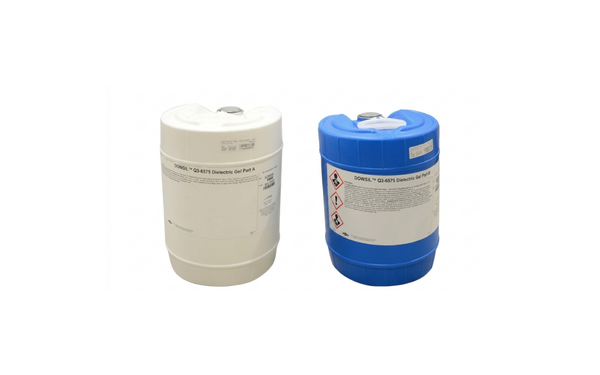
DOWSIL Q3-6575
Harmonization Code : 3910.00.00.90 | Silicones in Primary Forms; Others
Main features
- Clear 1:1 Dielectric Gel System
- 750 cP Mixed Viscosity
- Room-Temperature Encapsulation Cure
Product Description
DOWSIL Q3-6575 Dielectric Gel A/B Kit is a clear, two-part silicone gel with a 1:1 mix ratio and matched low viscosities for Part A, Part B, and the mixed material. It cures to a very soft gel and is documented for low-temperature flexibility, electrical insulation, and stress-relieving encapsulation of electronic assemblies. Documented applications include low-temperature pcb protection, electrical insulation, and stress-relief encapsulation. The two components can be handled manually for low-volume work or with meter-mix equipment for higher-volume processing.
Key features
- Mix ratio: Clear two-part silicone dielectric gel with a 1:1 mix ratio and about 750 cP viscosity for Part A, Part B, and mixed material.
- Processing window: Documented cure schedules include 24 h at 25 deg C, 40 min at 70 deg C, and 20 min at 100 deg C.
- Electrical performance: Typical cured properties include 18 kV/mm dielectric strength, 1.2 E+14 ohm-cm volume resistivity, and a very soft 75 g gel hardness.
Applications
- Low-temperature PCB protection
- Electrical insulation
- Stress-relief encapsulation
Technical Specifications
General Properties
Electrical Properties
Additional Information
Silicone Dielectric Gels
Very soft 1:1 dielectric gel for low-temperature electronic protection
DOWSIL Q3-6575 Dielectric Gel is a clear, two-part silicone gel with a 1:1 mix ratio and matched low viscosities for Part A, Part B, and the mixed material. It cures to a very soft gel and is documented for low-temperature flexibility, electrical insulation, and stress-relieving encapsulation of electronic assemblies.
As-Supplied Properties
Matched low-viscosity A/B components
Part A and Part B are documented at closely matched viscosities, supporting proportional mixing and dispensing of the 1:1 system.
| Property | Part A / Base | Part B / Catalyst | Mixed Material | State |
|---|---|---|---|---|
| Viscosity | 750 cP / 0.8 Pa-sec | 750 cP / 0.7 Pa-sec | 750 cP / 0.8 Pa-sec | Uncured |
| Specific gravity | - | - | 1.02 | Uncured |
| Mix ratio | - | - | 1:1 | Two-part system |
Processing
Mix, de-air, dispense, and select the cure schedule
The two components can be handled manually for low-volume work or with meter-mix equipment for higher-volume processing. Air management and proportioning are important because trapped gas or off-ratio mixing can affect the cured gel.
- Proportion and mix:Use the documented 1:1 A/B ratio. Matched component viscosities support static or dynamic mixing, while manual weighing and hand mixing may be suitable for low-volume applications.
- Manage entrained air:Avoid applying air pressure directly to the liquid gel surface when no bladder pack is used. Vacuum de-airing above 28 inHg, corresponding to about 10-20 mmHg residual pressure, may be necessary when a void-free protective layer is required.
- Dispense:Manual or automated meter-mix dispensing can be used depending on production volume and package geometry.
- Cure:Documented schedules include 24 h at 25 deg C, 40 min at 70 deg C, and 20 min at 100 deg C. Gel time at 135 deg C is 5.8 min.
Storage & Handling
Shelf life at controlled room temperature
The supplied technical data lists a shelf life of 12 months at 25 deg C. Keep component handling and storage conditions aligned with the packaged product instructions before mixing and dispensing.
Technical Guidance
Control cure inhibition, air, and thermal profile
The gel is soft and low viscosity, but successful processing still depends on compatibility of contacted materials, gas management, and cure verification on the actual assembly.
Check for cure inhibition
Organotin and other organometallic compounds, sulfur-containing materials, some unsaturated hydrocarbon plasticizers, and some solder-flux residues can inhibit addition cure. Run a small-scale compatibility check when a contacted material is uncertain.
Use controlled air handling
Bladder-pack dispensing avoids direct air contact with the liquid components. When using other packaging, minimize conditions that can supersaturate the liquid with air and create bubbles during cure.
Verify the cure on the assembly
Heat accelerates cure, but the part must reach the intended temperature. Cure schedules should be verified for the actual geometry and thermal mass.
Final-State Properties
Typical cured gel and dielectric properties
The cured material remains very soft while providing electrical insulation. Frequency-dependent electrical values are kept separate.
| Property | Typical Value | Unit / Condition | State |
|---|---|---|---|
| Gel hardness | 75 | grams | Cured gel |
| Penetration | 80 | 1/10 mm | Cured gel |
| Dielectric strength | 18 | kV/mm | Cured gel |
| Dielectric constant | 2.82 | 100 Hz | Cured gel |
| Dielectric constant | 2.83 | 100 kHz | Cured gel |
| Volume resistivity | 1.2 E+14 | ohm-cm | Cured gel |
| Dissipation factor | 0.002 | 100 Hz | Cured gel |
| Dissipation factor | <0.0001 | 100 kHz | Cured gel |
Applications
Electronic protection where a very soft gel is useful
The supplied product information positions low-temperature silicone gels for electrical insulation and stress-relieving encapsulation of electronic assemblies.
Low-temperature PCB protection
Encapsulation of PCB system assemblies where a very soft silicone gel and low-temperature flexibility are required.
Electrical insulation
Circuit protection where a dielectric gel is used to isolate electronics from moisture, contaminants, and high electrical potential.
Stress-relief encapsulation
Soft encapsulation around delicate components and interconnections to reduce mechanical constraint during thermal excursions.
Technical support for DOWSIL Q3-6575 Dielectric Gel
Need help evaluating Q3-6575 for a specific PCB, cavity depth, mixing method, degassing step, or cure schedule? Krayden can help review the A/B dispensing approach, air-management plan, cure temperature, assembly thermal mass, and the electrical or low-temperature requirements that matter for the intended protection layer.


