
DOWSIL SE 4485
Harmonization Code : 3506.10.00.00 | Prepared glues and other prepared adhesives, not elsewhere specified or included; products suitable for use as glues or adhesives, put up for retail sale as glues or adhesives, not exceeding a net weight of 1 kg
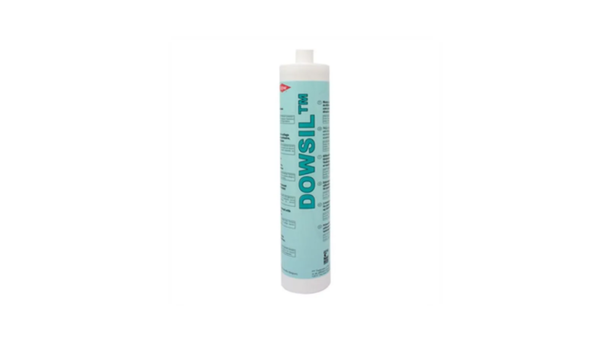
Main features
- 2.8 W/(m K) Thermal Conductivity
- One-Part Moisture-Cure Silicone
- Thermal-Bonding Electrical Insulation
Product Description
DOWSIL™ SE 4485 Thermally Conductive Adhesive is a one-part, white, semi-flowable silicone adhesive formulated for sealing, bonding and heat dissipation in electronic assemblies such as telecommunications devices and power-supply modules. The material cures at room temperature through exposure to atmospheric moisture and provides typical 2.8 W/m·K thermal conductivity, 10-minute tack-free time at 25°C, 1.2 MPa lap-shear adhesion, 90 Shore A hardness and 3.4 MPa tensile strength. Joint geometry, adhesive thickness, humidity, temperature and access to atmospheric moisture must be controlled because tack-free time is not full-depth cure.
Key features
- One-part, ready-to-use thermally conductive silicone adhesive
- Room-temperature moisture cure with no component mixing
- Typical 2.8 W/m·K thermal conductivity
- Fast 10-minute tack-free time at 25°C
- Semi-flowable white material for sealing and bonding
- Typical 1.2 MPa lap-shear adhesion and 3.4 MPa tensile strength
- UL 94 V-0 positioning, subject to the current recognised formulation and construction
Applications
- Telecommunications-electronics sealing and bonding
- Power-supply module thermal bonding and sealing
- Heat dissipation between electronic components and compatible substrates
- Moisture-accessible thermal-interface joints
TDS, SDS & Technical Documents
Technical Specifications
General Properties
Physical Properties
Electrical Properties
Thermal Properties
Additional Information
DOWSIL™ SE 4485 Thermally Conductive Adhesive
A one-part, white silicone adhesive that moisture-cures at room temperature to form a bonded thermal path in electronics assemblies. Its 2.8 W/m·K thermal conductivity, 10-minute tack-free time, and combined bonding and sealing functions support module designs that require heat transfer without a separate mechanical attachment layer.

Material and application characteristics
The product is supplied as a ready-to-use, one-part white adhesive, eliminating component proportioning and mixing. The reported values below are typical and should not be treated as specification limits.
| Property | Typical value / characteristic | Evaluation relevance |
|---|---|---|
| Number of parts | One part | No mix-ratio control is required before dispensing. |
| Colour | White | Supports visual identification during application and inspection. |
| Specific gravity | 2.9 | Useful for estimating material mass from dispensed volume. |
| Cure type | Room-temperature moisture cure | Allows curing without a dedicated heat-cure step, subject to access to atmospheric moisture. |
One-part dispensing and moisture cure
Dispense the one-part adhesive onto the prepared assembly, bring the mating surfaces into the intended joint geometry, and allow exposure to atmospheric moisture for room-temperature cure. The reported tack-free time is 10 minutes; tack-free condition is a surface-cure milestone and must not be interpreted as full cure or final strength.
- Control the dispensed amount and bondline geometry for the intended thermal and mechanical design.
- Keep the curing joint accessible to moisture; highly confined or deep sections require application-specific validation.
- Confirm adhesion, cure development, and final performance on the actual substrates and production process.
.png)
1. Dispense
Apply the ready-to-use adhesive in a controlled bead or pattern appropriate to the joint and required coverage.
2. Assemble
Mate the surfaces and maintain the intended bondline without displacing the adhesive from the heat-transfer area.
3. Moisture cure
Allow room-temperature exposure to atmospheric moisture. Verify cure development for the actual joint depth and environment.
4. Validate
Confirm adhesion, thermal performance, and handling readiness using the intended substrates, bondline, and cure conditions.
Storage and handling
Use the current product label, sales specification, and regional safety documentation for storage temperature, shelf life, packaging, and handling controls. Keep the container closed when not dispensing to limit unintended moisture exposure. Do not publish or apply a storage limit that has not been verified for the supplied regional grade and package.
Thermal, mechanical, and adhesion properties
These are typical laboratory values. Thermal conductivity is a bulk-material property and does not by itself define installed interface resistance, which also depends on bondline thickness, contact quality, joint area, and assembly conditions.
| Property | Typical value | Interpretation boundary |
|---|---|---|
| Thermal conductivity | 2.8 W/m·K | Bulk property; installed thermal resistance depends on the complete bondline and interfaces. |
| Lap shear adhesion | 1.2 MPa | Reported for the aluminium lap shear joint; do not generalise to other substrates or surface conditions. |
| Tensile strength | 3.4 MPa | Bulk cured-material property, not a universal bonded-joint strength. |
| Elongation at break | 25% | Tensile specimen property; it does not independently establish joint movement or thermal-cycle durability. |
| Hardness | 90 Shore A | Cured-material hardness; it does not define compression force or installed bondline stress. |
Electronics module bonding with heat-transfer requirements
Application suitability depends on the actual substrates, bondline, joint loading, cure access, electrical requirements, and operating environment. The contexts below reflect documented product positioning and require assembly-level validation.
.png)
.png)

Thermally conductive materials training
These two Dow training modules provide complementary context: the first explains the purpose and selection role of thermally conductive materials, while the second focuses on handling, dispensing, curing, packaging, and storage considerations.
Purpose and when to use
Introduces the role of thermal materials in electronic heat management and helps frame when an adhesive, gap filler, compound, or other thermal solution may be appropriate.
How to use
Reviews dispensing, curing, packaging, and storage topics that are relevant when evaluating a one-part moisture-cure thermal adhesive process.
Evaluate DOWSIL™ SE 4485 for your bonded thermal interface
Krayden can help review substrate selection, joint geometry, bondline control, cure access, dispensing approach, and the thermal and mechanical requirements of your electronics assembly before production evaluation.


