
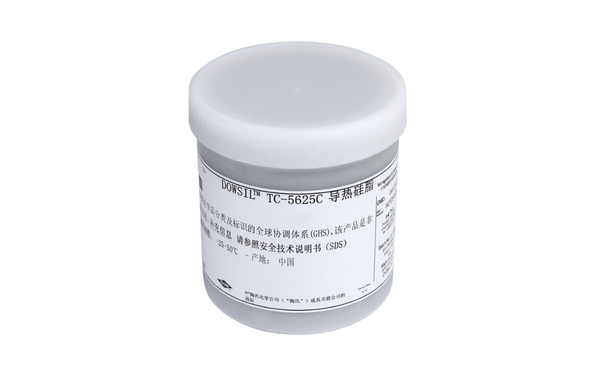
DOWSIL TC-5625C
Harmonization Code : 3506.91.90.99 | Prepared glues and other prepared adhesives, not elsewhere specified or included; products suitable for use as glues or adhesives, put up for retail sale as glues or adhesives, not exceeding a net weight of 1 kg ; Adhesives based on polymers of headings 3901 to 3913 or on rubber; Other ; Other
Main features
- One-Part Non-Curing Thermal Interface Compound
- Thermally Conductive Thermal Interface
- Screen, Stencil, or Dispense Application
Product Description
DOWSIL TC-5625C Thermally Conductive Compound is a one-part, greenish-yellow, flowable, non-curing silicone thermal interface compound. It supports screen printing, stencil printing, and dispensing for controlled heat-transfer interfaces. Typical bulk thermal conductivity is 2.7 W/m-K, and thermal resistance is reported as 0.09 deg C-cm2/W at 40 psi under the documented test configuration. Applications include lamps, luminaires, and circuitry cooling. Interface performance should be evaluated with bond-line thickness, pressure, surface condition, and the complete assembly in view.
Key features
- Application fit: One-part, non-curing silicone thermal interface compound.
- Thermal performance: Typical thermal conductivity: 2.7 W/m-K.
- Flow and dispensing: Supports screen printing, stencil printing and dispensing.
Applications
- Lamps
- Luminaires
- Circuitry cooling
TDS, SDS & Technical Documents
Technical Specifications
General Properties
Physical Properties
Thermal Properties
Electrical Properties
Additional Information
THERMAL INTERFACE MATERIAL
DOWSIL TC-5625C for controlled non-curing thermal interfaces
A one-part, greenish-yellow, flowable silicone thermal compound designed for thermal-interface use without chemical cure. The technical data supports screen printing, stencil printing and dispensing, together with typical thermal conductivity and thermal resistance data that must be evaluated in their documented interface context.
AS-SUPPLIED PROPERTIES
As-supplied product characteristics
The documented product description defines the material before installation.
| Property | Value | Condition |
|---|---|---|
| Product form | One-part silicone thermal compound | As supplied |
| Appearance | Greenish-yellow | As supplied |
| Rheology | Flowable | As supplied |
| Cure behavior | Non-curing | As supplied and installed |
PROCESSING
Application methods supported by the technical record
TC-5625C is documented for screen printing, stencil printing and dispensing. Application control should focus on placing a consistent thermal-interface layer rather than treating the material as a curing adhesive.
- Prepare the intended thermal-interface surfaces according to the assembly process.
- Apply by screen printing, stencil printing or dispensing as appropriate to the assembly.
- Assemble the interface to the required bond-line and contact condition.
Process boundary
The material is non-curing. Thermal conductivity and thermal resistance data should not be converted into package-level cooling claims without the relevant bond-line thickness, pressure, surfaces and system test conditions.
TECHNICAL GUIDANCE
Evaluate the installed interface, not conductivity alone
TC-5625C should be assessed as a non-curing TIM whose installed behavior depends on the complete interface configuration.
Bond-line control
Use the intended application process to control the deposited layer and final interface thickness.
Pressure context
Retain the documented pressure condition when interpreting thermal-resistance data.
System evaluation
Confirm performance in the actual heat source, mating surface and assembly rather than extrapolating from bulk material data alone.
THERMAL DATA
Documented thermal-interface data
The technical data records these values as typical product data.
| Property | Typical value | Condition / qualification |
|---|---|---|
| Thermal conductivity | 2.7 W/m-K | Typical |
| Thermal resistance | 0.09 deg C-cm2/W | At 40 psi under the documented test configuration |
Thermal conductivity and thermal resistance are distinct metrics. Interface performance depends on bond-line thickness, pressure, surface condition and the complete assembly.
APPLICATIONS
Documented application context
The product uses thermal-interface use for heat dissipation from circuitry.
Lamps
Thermal-interface use in documented mid- to high-end lamp assemblies.
Luminaires
Heat-transfer interfaces in documented luminaire applications.
Circuitry cooling
General circuitry heat-dissipation interface use within the supported product scope.
Discuss your application with Krayden
For TC-5625C selection, share your interface geometry, target bond-line, assembly pressure, application method and thermal requirements so Krayden can help align the material data with the actual cooling interface. Krayden can also help review the documented processing conditions and evaluation criteria before testing.


