
Bi58Sn42 | Eutectic Pbfree Solder Spheres
Harmonization Code : 8001.20 | Unwrought tin: Tin alloys


Main features
- Leadfree Solder Spheres
- Lowest Cost Eutectic (138°C) Solder
- Low-Temperature Eutectic Solder
Product Description
LINQALLOY Bi58Sn42 Low-temperature eutectic solder spheres are lead-free Bismuth-Tin alloys that contain 58% Bismuth (Bi), 42% Tin (Sn) and are often written as 58Bi42Sn, Sn42Bi58, or 42Sn58Bi. Bi58Sn42 Solder Spheres are low-temperature, lead-free, eutectic solder spheres and are used by companies working with BGA, CSP, LBGA, PBGA and CBGA components who have made the transition to Lead-free (Pb-free) soldering.
Features:
- Lowest Cost Eutectic (138°C) Solder
- Low-Temperature Eutectic Solder compared to Tin-Silver
- Compatible with many Flux Types
- Lead-free
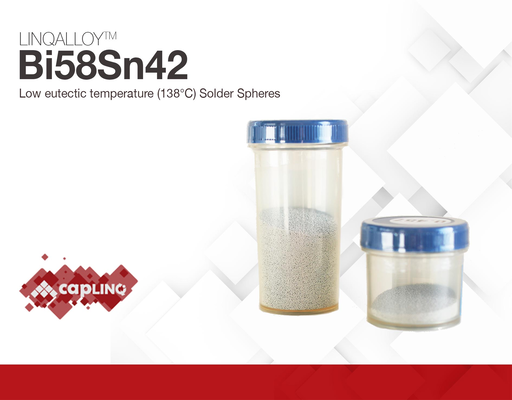
Each jar has a clear label on the lid specifying the solder ball diameter as well as a label on the front identifying the alloy type, the quantity of spheres in the jar, the date of manufacture, and the product lot (or batch) number. This batch number is also tied to a certificate of conformance that is provided with the solder spheres and ensures the Bi58Sn42 solder spheres meet the following quality criteria:
- Tin (Sn): 42%
- Bismuth (Bi): 58%
- Eutectic Temperature: 138°C
- Melting Temperature (Solidus): 138°C
- Melting Temperature (Liquidus): 138°C
- Sphericity: Within 1.5%
Diameter Tolerance
- 0.1mm - 0.25mm (100µm - 250µm) : ± 0.0050mm (± 5µm)
- 0.3mm - 0.45mm (300µm - 450µm) : ± 0.010mm (± 10µm)
- 0.5mm - 0.89mm (500µm - 890µm) : ± 0.020mm ( ± 20µm)
LINQ Bi58Sn42
 Shipping in 6 weeks
 Shipping in 6 weeks
 Shipping in 6 weeks
TDS, SDS & Technical Documents
Technical Specifications
General Properties
Other Properties
Additional Information
The solder spheres you receive are originally manufactured solder spheres packed into jars with inert gas (nitrogen). We do not repack the solder balls, so the jars you will receive have never been opened, thus ensuring the quality of the product. The lid of the jar is also always sealed with a shrink-wrapped plastic wrap ensuring that the solder spheres do not oxidate in the jar.


