
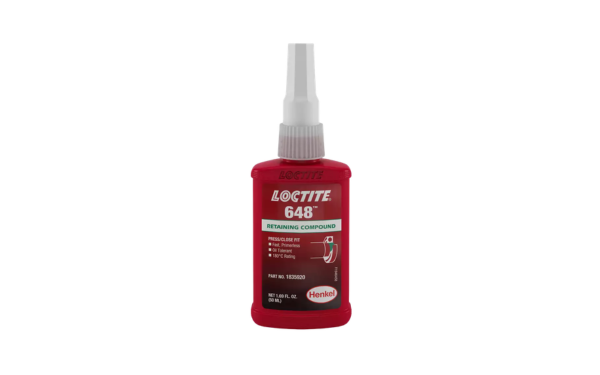
LOCTITE 648
Harmonization Code : 3919.10.80 | Other self-adhesive plastic rolls not exceeding 20 cm wide.
Main features
- High-Strength Cylindrical Retention
- Metal Compatibility Cylindrical Retention
- Heat, Oil, and Contamination Resistance
Product Description
LOCTITE® 648™ is a one-component, high-strength anaerobic retaining compound designed for bonding close-fitting cylindrical metal parts, particularly assemblies with bond gaps approaching 0.15 mm. The low-viscosity green urethane methacrylate liquid cures when confined between mating metal surfaces in the absence of air, helping prevent loosening and leakage caused by shock and vibration. It performs on active and passive metals, tolerates minor surface contamination from industrial oils, and is commonly used to retain gears and sprockets on gearbox shafts and rotors on electric-motor shafts.
Key features
- High-strength cylindrical retention: Develops up to 31 N/mm² compressive shear strength on steel pins and collars after a 72-hour cure.
- Broad metal compatibility: Works on active metals such as mild steel and passive substrates including stainless steel and plated surfaces.
- Heat, oil, and contamination tolerance: Supports elevated-temperature applications and tolerates minor contamination from cutting, lubricating, anti-corrosion, and protective fluids.
TDS, SDS & Technical Documents
Technical Specifications
General Properties
Physical Properties
Additional Information
As-supplied / before-processing properties
Typical properties of the uncured material; values are reference data rather than guaranteed product specifications.
| Property | Value | Unit | Method / condition |
|---|---|---|---|
| Technology | Acrylic | — | Uncured material |
| Chemical type | Urethane methacrylate | — | Uncured material |
| Appearance | Green liquid | — | Uncured material |
| Fluorescence | Positive under UV light | — | Inspection aid |
| Components | One component | — | No mixing required |
| Viscosity classification | Low | — | Retaining application |
| Cure mechanism | Anaerobic | — | Cures when confined between close-fitting metal surfaces without air |
| Secondary cure | Activator | — | May accelerate cure on passive metals or in larger gaps |
| Strength classification | High | — | Cylindrical retaining application |
| Specific gravity | 1.1 | — | At 23°C; TDS value |
| Dynamic viscosity | 500 | mPa·s | Brookfield RVT, 25°C; spindle 2, 20 rpm |
| Dynamic viscosity | 500 | mPa·s | Cone and plate, 25°C; shear rate 129 s−1 |
| Dynamic viscosity range | 450–550 | mPa·s | SDS value; method not stated |
| Density | 1.1 | g/cm³ | At 20°C; SDS value |
| Flash point | >100 | °C | SDS value |
After-processing / final-state properties
Typical cured-material properties depend on substrate, bond gap, temperature, activator use, cure time, surface condition, and test method.
| Property | Value | Unit | Method / condition |
|---|---|---|---|
| Glass-transition temperature | 100 | °C | ISO 11359-2; cured 24 hours at 23°C |
| Coefficient of thermal expansion below Tg | 93 × 10−6 | K−1 | ISO 11359-2 |
| Coefficient of thermal expansion above Tg | 184 × 10−6 | K−1 | ISO 11359-2 |
| Compressive shear strength | 13.5 | N/mm² | ISO 10123; steel pins and collars; cured 15 minutes at 23°C |
| Compressive shear strength | 31 | N/mm² | ISO 10123; steel pins and collars; cured 72 hours at 23°C |
| Compressive shear strength | 30 | N/mm² | ISO 10123; stainless-steel pins and collars; cured 72 hours at 23°C |
| Compressive shear strength | 18 | N/mm² | ISO 10123; aluminum pins and collars; cured 72 hours at 23°C |
| Breakaway torque | 58 | N·m | ISO 10964; M10 black-oxide bolts and mild-steel nuts; cured 72 hours at 23°C |
| Prevail torque | 40 | N·m | ISO 10964; M10 black-oxide bolts and mild-steel nuts; cured 72 hours at 23°C |
| Motor-oil resistance | 145 | % initial strength | 5W40 synthetic motor oil at 125°C; 5,000-hour exposure |
| Unleaded-petrol resistance | 105 | % initial strength | At 23°C; 5,000-hour exposure |
| Brake-fluid resistance | 125 | % initial strength | At 23°C; 5,000-hour exposure |
| Water/glycol resistance | 80 | % initial strength | 50/50 water/glycol at 87°C; 5,000-hour exposure |
| Ethanol resistance | 120 | % initial strength | At 23°C; 5,000-hour exposure |
| Acetone resistance | 100 | % initial strength | At 23°C; 5,000-hour exposure |
| B100 biodiesel resistance | 100 | % initial strength | At 23°C; 5,000-hour exposure |
| DEF resistance | 100 | % initial strength | AdBlue-type diesel exhaust fluid at 23°C; 5,000-hour exposure |


