
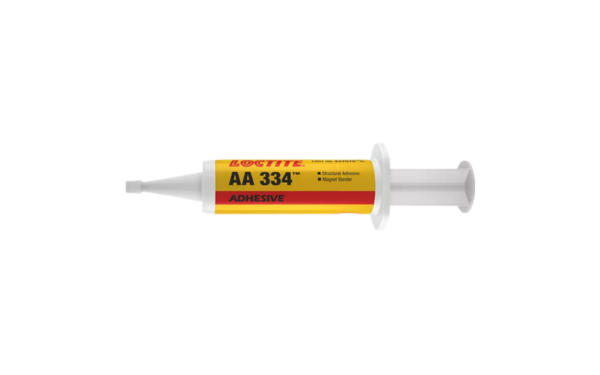
LOCTITE AA 334
Harmonization Code : 3506.10.00.00 | Prepared glues and other prepared adhesives, not elsewhere specified or included; products suitable for use as glues or adhesives, put up for retail sale as glues or adhesives, not exceeding a net weight of 1 kg
Main features
- Permanent Acrylic Bonding
- Tough Structural Bonding
- Flexible Cured Adhesive
Product Description
LOCTITE® AA 334™ is a one-component, high-viscosity, activator-cured structural acrylic adhesive designed primarily for securing permanent magnets in electric-motor assemblies. The light-yellow to dark-yellow-brown liquid requires no adhesive mixing and develops tough, durable bonds with strong impact and peel resistance. It can accommodate bond gaps up to 0.5 mm under specified activator conditions and may also be heat-cured or heat-accelerated when surface priming is undesirable.
Key features
- Permanent-magnet bonding: Designed for securing magnets in motor and other rigid metal assemblies.
- Tough structural performance: Provides strong lap-shear, impact, and peel resistance in demanding bonded joints.
- Flexible cure options: Cures with LOCTITE Activator 7387 and can also be accelerated or completed using controlled heat.
TDS, SDS & Technical Documents
Technical Specifications
General Properties
Physical Properties
Additional Information
As-supplied / before-processing properties
Typical uncured and processing properties; cure response depends on activator placement, bond gap, substrate, temperature, assembly time, and optional heat exposure.
| Property | Value | Unit | Method / condition |
|---|---|---|---|
| Technology | Acrylic | — | Structural adhesive technology |
| Chemical type | Modified acrylic | — | Uncured material |
| Appearance | Light yellow to dark yellow-brown liquid | — | TDS lists light yellow; SDS lists dark yellow to brown |
| Components | One component | — | Adhesive requires no mixing |
| Viscosity classification | High | — | TDS classification |
| Primary cure mechanism | Activator | — | LOCTITE Activator 7387 |
| Secondary cure mechanism | Heat | — | Used to effect or accelerate cure |
| Specific gravity | 1.05 | — | At 25°C; TDS |
| Density | 1.05 | g/cm³ | At 20°C; SDS |
| Particle size | ≤254 | µm | TDS value |
| Dynamic viscosity | 50,000–120,000 | mPa·s | Brookfield HBT, 25°C, spindle TB, 20 rpm |
| Kinematic viscosity | 57,000–85,000 | mm²/s | At 25°C; SDS |
| Flash point | 81.5 | °C | Pensky-Martens closed cup; SDS |
| Recommended minimum bond gap | 0.05 | mm | Fixture and lap-shear test condition |
| Maximum stated bond gap | 0.5 | mm | Activator required on both surfaces; immediate assembly |
| Fixture time | <2 | min | ISO 4587, steel, 0.05 mm gap, Activator 7387 on one side |
| Fixture time | 15 | min | ISO 4587, steel, 0.25 mm gap, Activator 7387 on one side |
| Fixture time | 60 | min | ISO 4587, steel, 0.5 mm gap, Activator 7387 on one side |
| Heat-cure schedule | 121°C / 20 min | — | Typical bondline heating condition |
| Heat-cure schedule | 149°C / 10 min | — | Typical bondline heating condition |
| Heat-cure schedule | 177°C / 5 min | — | Typical bondline heating condition |
After-processing / final-state properties
Typical cured properties depend on substrate, activator placement, bond gap, cure time, heat exposure, temperature, and test method.
| Property | Value | Unit | Method / condition |
|---|---|---|---|
| Shore hardness | 70 | Shore D | ISO 868 |
| Tensile modulus | 1,250 | N/mm² | ISO 527-2 |
| Tensile strength at break | 21 | N/mm² | ISO 527-2 |
| Lap-shear strength | ≥11 | N/mm² | ISO 4587, steel, 0.05 mm gap, 24 h at 22°C, Activator 7387 on one side |
| Lap-shear strength | ≥3.5 | N/mm² | ISO 4587, steel, 0.5 mm gap, 24 h at 22°C, Activator 7387 on one side |
| 180° peel strength | 4.4 | N/mm | ISO 8510-2, steel |
| Hot-strength retention | Approx. 75 | % initial strength | Approximately 50°C; tested hot; chart-derived |
| Hot-strength retention | Approx. 48 | % initial strength | Approximately 100°C; tested hot; chart-derived |
| Hot-strength retention | Approx. 18 | % initial strength | Approximately 150°C; tested hot; chart-derived |
| Heat-aging retention | 110 | % initial strength | 1,000 h at 90°C; tested at 22°C |
| Heat-aging retention | 100 | % initial strength | 1,000 h at 120°C; tested at 22°C |
| Heat-aging retention | 105 | % initial strength | 1,000 h at 150°C; tested at 22°C |
| Heat-aging retention | 100 | % initial strength | 1,000 h at 175°C; tested at 22°C |
| Heat-aging retention | 10 | % initial strength | 1,000 h at 200°C; tested at 22°C |
| Water/glycol resistance | 110 | % initial strength | 50/50 water/glycol, 87°C, 720 h; tested at 22°C |
| Unleaded-gasoline resistance | 15 | % initial strength | 87°C, 720 h; tested at 22°C |
| Motor-oil resistance | 110 | % initial strength | 87°C, 720 h; tested at 22°C |
| Automatic-transmission-fluid resistance | 90 | % initial strength | 87°C, 720 h; tested at 22°C |
| Brake-fluid resistance | 0 | % initial strength | 87°C, 720 h; tested at 22°C |


