
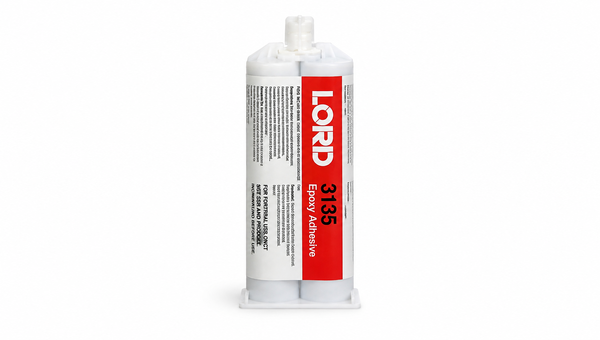
LORD 3135
Harmonization Code : 3506.91.90.99 | Prepared glues and other prepared adhesives, not elsewhere specified or included; products suitable for use as glues or adhesives, put up for retail sale as glues or adhesives, not exceeding a net weight of 1 kg ; Adhesives based on polymers of headings 3901 to 3913 or on rubber; Other ; Other
Main features
- Broad Multi-Material Structural Bonding
- Low-Shrinkage Epoxy System
- Documented NASA/MMM-A-134/MIL-A-8623A Compliance
Product Description
LORD® 3135-A/3135-B Epoxy Adhesive is a two-component epoxy structural adhesive for bonding most metals, wood, glass, concrete, masonry and various synthetic materials. It is particularly suited to bonding skins to plastic or metal honeycomb cores, polyurethane foams, and phenolic or epoxy laminates. The system supports room-temperature or accelerated heat curing and develops high-strength bonds with bondline flexibility, low cure shrinkage, good electrical resistance, and resistance to mechanical impact, shock and solvents.
Key Features
- Broad substrate adhesion to metals, wood, glass, concrete, masonry and supported synthetic materials.
- Low-stress structural bonding with low cure shrinkage, bondline flexibility and good electrical resistance.
- Qualified performance meeting NASA Low Outgassing Specification, MMM-A-134 Type 1 and 2, and MIL-A-8623A Type 1 and 2 requirements.
- Flexible curing options including approximately 24 hours at 77°F (25°C) or supported accelerated heat-cure schedules.
Applications / Suitable for
- Bonding skins to plastic or metal honeycomb cores
- Polyurethane foam bonding
- Phenolic and epoxy laminate bonding
- Structural bonding of metals, wood, glass, concrete, masonry and supported synthetic materials
TDS, SDS & Technical Documents
Technical Specifications
General Properties
Physical Properties
Thermal Properties
Additional Information
As-Supplied / Before-Processing Properties
Typical component and mixed properties. Values are typical and are not intended for specification purposes.
| Property | 3135-A Resin | 3135-B Hardener | Mixed | Method / Condition |
|---|---|---|---|---|
| Appearance | Amber liquid | Amber liquid | Straw yellow liquid | Typical |
| Viscosity | 12,000–14,500 cP | 25,000–50,000 cP | — | Brookfield at 77°F (25°C) |
| Density | 9.75 lb/gal (1.17 g/cm³) |
8.01 lb/gal (0.96 g/cm³) |
— | Typical |
| Flash Point | ≥201°F (≥93°C) |
≥201°F (≥93°C) |
— | Closed cup |
| Mix Ratio | 1 part | 1 part | 1:1 | Resin to hardener, by weight |
| Solids Content | — | — | 100% | Mixed adhesive |
| Recommended Induction Period | — | — | 15 minutes | After mixing and before application |
| Working Time | — | — | 1.5–3 hours | At 77°F (25°C) |
| Time to Handling Strength | — | — | 8–12 hours | Typical |
| Suggested Bondline Thickness | — | — | 2–5 mil 6–10 mil |
Non-porous surfaces Porous surfaces |
| Shelf Life | 2 years | 2 years | — | Store at 73°F (23°C) in a clean, dry environment in original, unopened containers |
After-Processing / Final-State Properties
Typical cured properties. Values are typical and are not intended for specification purposes.
| Property | Value | Unit | Method / Condition |
|---|---|---|---|
| Cure to Full Strength | Approximately 24 | hours | At 77°F (25°C) |
| Accelerated Cure | 45 minutes 1 hour 3 hours |
— | At 121°C At 93°C At 65°C |
| Cured Appearance | Amber to clear | — | Typical |
| Volume Resistivity | 1.25 × 10¹⁴ | ohm/cm | ASTM D257-252T |
| Coefficient of Linear Thermal Expansion | 57.6 | ppm/°C | Typical |
| Hardness | 82 | Shore D | Typical |
| Dielectric Strength | 460 | V/mil | ASTM D149-44; 60 cycles at room temperature |
| Dielectric Constant | 3.24 | — | ASTM D159-47T; 60 cycles at room temperature |
| Arc Resistance | 78 | seconds | ASTM D495-48T |
| Lap Shear Strength | 3800 (26.2) |
psi (MPa) |
2024-T3 clad aluminum at 75°F (24°C) |
| Lap Shear Strength after Humidity Exposure | 3900 (26.9) |
psi (MPa) |
At 75°F (24°C) after 720 hours at 100% RH and 161°F (72°C) |
| Lap Shear Strength after Salt Spray Exposure | 3200 (22.1) |
psi (MPa) |
At 75°F (24°C); salt spray exposure per MIL-A-005090C and Federal Test Method Standard 152 |


