
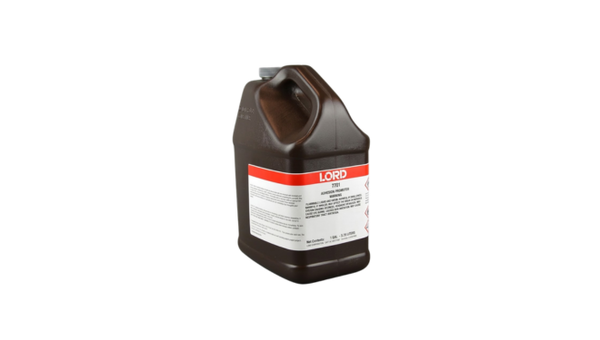
LORD 7701
Harmonization Code : 3208.20.90 | Paints and varnishes that are dispersed or dissolved in a non aqueous medium
Main features
- Cured-Rubber/Urethane/Elastomer Adhesion Treatment
- No-Mix Wipe/Brush/Dip/Flood Application
- Compatible LORD Epoxy/Urethane Adhesives
Product Description
LORD® 7701 Adhesion Enhancer/Surface Modifier is a solvent-based surface treatment for cured and thermoplastic polymeric materials. It chemically alters elastomer surfaces to make them more receptive to bonding with compatible epoxy and urethane adhesives. LORD 7701 is designed for natural rubber, synthetic polyisoprene, SBR, butyl, polybutadiene, neoprene, EPDM, nitrile, polyurethane, styrenic block copolymers, and PVC. It requires no mixing, applies by wipe, brush, dip, or flood, and is ready for assembly after the ethyl-acetate solvent flashes off in less than five minutes. Do not apply LORD 7701 to metal surfaces.
Key features
- Reactive surface treatment for cured rubber and thermoplastic elastomers
- Functions as both a cleaner and surface conditioner
- Requires no mixing or post-treatment rinse
- Preferred wipe application with brush, dip, and flood alternatives
- Less than five-minute solvent flash-off under suitable conditions
- Improves adhesion to cured rubber and cast urethane
- Supports compatible LORD epoxy and urethane adhesive systems
Applications
- Cured-rubber-to-metal assemblies used with a compatible structural adhesive
- Natural rubber, SBR, nitrile, EPDM, neoprene, and polyurethane treatment
- Cast-urethane bonding processes
- Thermoplastic elastomer and PVC surface conditioning
TDS, SDS & Technical Documents
Technical Specifications
General Properties
Thermal Properties
Additional Information
LORD® 7701 Adhesion Enhancer/Surface Modifier
A clear-to-cloudy, ethyl-acetate-based surface treatment that chemically modifies cured and thermoplastic elastomers before adhesive application. It is used with compatible LORD epoxy and urethane adhesives and must be applied to the rubber or polymer surface—not to the metal substrate.
.png)
Low-solids reactive treatment in ethyl acetate
| Property | Typical value | Context |
|---|---|---|
| Appearance | Clear to cloudy liquid | Visual condition; confirm acceptability against the controlled product specification. |
| Density | 870–930 kg/m³ | Equivalent to 7.3–7.8 lb/gal. |
| Solids content | 2.3–3.5% by weight | Low-solids reactive surface treatment. |
| Solvent | Ethyl acetate | Current SDS identifies approximately 95–100% ethyl acetate. |
| Flash point | -4°C | Seta method; highly flammable liquid and vapour. |
| Mixing | None required | Prevent contamination during transfer and application. |
Treat the elastomer surface before applying a compatible adhesive
Natural rubber, synthetic polyisoprene, SBR, butyl, polybutadiene, neoprene, EPDM, nitrile, and polyurethane.
Styrene-butadiene and styrene-isoprene block copolymers, thermoplastic elastomers, and PVC after validation.
Published for use with a broad range of LORD epoxy and urethane adhesives used to bond cured rubber.
Do not apply LORD 7701 to metal surfaces. Prepare the metal separately according to the selected adhesive system.
Remove contamination and apply the minimum necessary treatment
- Remove contamination from the rubber or polymer surface with a validated solvent wipe.
- Transfer only the minimum required quantity into a new, clean, compatible container.
- Use wiping as the preferred application method with a clean cotton rag.
- Change wiping rags frequently as they collect contamination.
- Brush with compatible bristle or foam brushes; use synthetic bristles.
- Do not allow metal brush handles or collars to contact LORD 7701.
- For dipping, rack treated parts so excess material can drain and the solvent can flash off.
- Flood application is supported where contamination and excess-material control can be maintained.
- Spray application is not recommended because of the material's reactivity.
- Discard transferred or excess material; never return it to the original container.
.png)
Assemble shortly after the ethyl acetate flashes off
Treatment is complete after the solvent flashes off, typically in less than five minutes under suitable airflow.
Rinsing is not required after the solvent has evaporated.
Best bonds are obtained by assembling shortly after flash-off. Validate any treated-part storage interval.
Parts may be retreated when necessary, provided contamination and process compatibility are controlled.
Storage, handling, and safety
Shelf life is six months from date of shipment at 21–27°C in the original unopened container. Store in a cool, dark, well-ventilated area using the original or a compatible UV-filtering plastic or glass container. Do not store in metal containers. Keep away from oil, grease, sawdust, floor sweepings, readily oxidised organic materials, ammonia, amines, ammonia salts, metallic materials, water, and alcohol. The current US SDS classifies LORD 7701 as a highly flammable liquid and vapour that causes serious eye irritation, may cause drowsiness or dizziness, and is toxic to aquatic life with long-lasting effects. Use explosion-proof ventilation and electrical equipment, non-sparking tools, grounding and bonding, suitable gloves, protective clothing, and eye and face protection.
Adhesion results depend on the complete treatment, adhesive, rubber, metal preparation, and cure system
Published 45° peel data used 0.3 × 15 × 2 cm rubber specimens bonded to grit-blasted steel and cured for 48 hours at room temperature. Epoxy testing used LORD 305-1/305-2 or LORD 320/310B systems. Values are typical and not specification limits.
| Test system | Rubber substrate | Typical result | Failure mode |
|---|---|---|---|
| Epoxy adhesive with LORD 7701 | Natural rubber | 40–50 pli | 100% rubber failure |
| Epoxy adhesive with LORD 7701 | SBR | 105–120 pli | 100% rubber failure |
| Epoxy adhesive with LORD 7701 | Nitrile | 75–85 pli | 100% rubber failure |
| Cast polyurethane with LORD 7701 | Natural rubber | 105–120 pli in DS3223E; an older DS3461 copy reports a conflicting range | 100% rubber failure |
| Cast polyurethane with LORD 7701 | SBR | 75–85 pli | 100% rubber failure; stock break also reported |
| Cast polyurethane with LORD 7701 | Nitrile | 70–80 pli | 100% rubber failure |
| Cast polyurethane with LORD 7701 | Polychloroprene | 40–50 pli | 100% rubber failure |
ASTM D429-B, 45° angle. Do not compare these values without preserving adhesive chemistry, rubber compound, metal preparation, specimen dimensions, cure, and failure mode.
Control cleanliness, treatment coverage, flash-off, and time to adhesive application
LORD 7701 is appropriate where cured-rubber or elastomer adhesion is limited by surface chemistry and a compatible adhesive system is available. Final qualification should address rubber formulation and cure state, blooming, mould release, solvent-wipe compatibility, application method, coverage, contamination, airflow, flash-off, treated-part storage, retreatment, adhesive wetting, metal preparation, cure, environmental ageing, and desired failure mode.
Apply LORD 7701 only to the rubber; prepare the metal according to the selected adhesive TDS.
Use the treatment to improve wetting and adhesion to supported elastomer surfaces.
Use clean transfer containers, frequent rag replacement, compatible tools, and strict segregation from metal and reactive contaminants.
LORD 7701 technical, safety, and bonding guidance
LORD-branded technical data supporting substrate scope, application methods, flash-off, storage, typical properties, and bond-performance evidence.
Open resourceCurrent Parker technical data for the corresponding 7701 surface treatment, including application, storage, and performance details.
Open resourceCurrent US safety information for flammability, exposure controls, handling, storage, spill response, transport, and disposal.
Open resourceGeneral substrate preparation, joint-design, adhesive application, fixturing, failure-mode, cleanup, and qualification guidance.
Open resourceValidate LORD® 7701 for your elastomer and adhesive combination
Krayden can help review rubber chemistry, surface contamination, application method, flash-off, tool and container compatibility, treated-part storage, adhesive selection, metal preparation, failure mode, environmental exposure, and production safety controls.


