
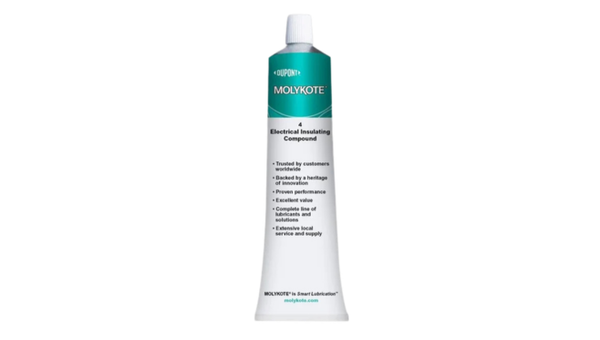
MOLYKOTE 4
Harmonization Code : 3403.19 | Lubricating Preparations (With 70% or More Petroleum Oils) For Automotive and Other Uses
Main features
- 54 to 200 deg C Service Range
- 3 ohm-cm Volume Resistivity
- Flowable Controlled Placement
Product Description
MOLYKOTE® 4 Electrical Insulating Compound is a semi-flowable silicone-based compound used as a lubricant, moisture-resistant seal, and electrical insulating material in connectors, terminals, seals, and mixed metal-to-polymer or metal-to-rubber assemblies. Its documented temperature range is -54°C to 200°C, with ASTM D1478 low-temperature torque data measured at -54°C. Typical electrical results include 338 V/mil dielectric strength at 50 mil thickness, volume resistivity of 4.62 × 10¹³ ohm-cm at 23°C, and 225 seconds mean arc resistance. The compound can be applied by hand, brush, or wiping; its flow response increases with shear, so automated dispensing and containment should be validated for the intended process.
Key features
- Broad documented temperature range: -54°C to 200°C, with low-temperature starting and running torque measured at -54°C.
- Electrical insulating properties: Typical dielectric strength of 338 V/mil at 50 mil thickness and volume resistivity above 4 × 10¹³ ohm-cm at 23°C and 177°C.
- Semi-flowable silicone consistency: Unworked penetration of 200–250 mm/10; shear can increase flow into complex geometries.
- Moisture and retention data: Waterproof-seal testing passed at 25°C for 24 hours, with 1.1% evaporation and 4.4% bleed after 30 hours at 204°C.
- Flexible application methods: Apply by hand, brushing, or wiping; automated dispensing is possible when pump shear and rheology variation are validated.
Applications / Suitable for
- Cable connectors, sealed electrical connectors, disconnect junctions, and terminals
- Battery terminals and ignition-system sealing and lubrication
- Rubber seals and elastomer or polymer O-rings
- Metal-on-polymer and metal-on-rubber assembly interfaces
- Transportation and industrial moisture-resistant electrical sealing
TDS, SDS & Technical Documents
Technical Specifications
No specifications available.
Additional Information
MOLYKOTE® 4 Electrical Insulating Compound
A semi-flowable silicone-based compound for lubricating, sealing, and electrically insulating connectors, terminals, elastomer seals, O-rings, and mixed metal-to-polymer or metal-to-rubber interfaces. It combines a -54°C to 200°C documented temperature range with moisture resistance, low evaporation, and condition-specific dielectric, resistivity, and arc-resistance data.

MOLYKOTE® 4 is supplied as a light-gray to translucent-white, semi-flowable silicone compound.
As-supplied compound properties
| Property | Typical result | Unit | Method / condition |
|---|---|---|---|
| Color | Light gray to translucent white | — | As supplied |
| Penetration, unworked | 200–250 | mm/10 | ASTM D217 |
| Penetration, worked 60 strokes | 310 max | mm/10 | ASTM D217 |
| Worked penetration after thermal exposure | 310 max | mm/10 | ASTM D217 / AMS8660; 60 strokes after 24 hours at 204°C |
| Bleed | 4.4 | % | AMS8660; 30 hours at 204°C |
| Evaporation | 1.1 | % | AMS8660; 30 hours at 204°C |
| Low-temperature starting torque | 676 | gm-cm | ASTM D1478 at -54°C |
| Low-temperature running torque | 197 | gm-cm | ASTM D1478; after 60 minutes at -54°C |
Typical values are not specification limits. Temperature, penetration, bleed, evaporation, and torque results are condition-specific and should not be converted into universal equipment-life or dispensing-performance claims.
Electrical and thermal properties
| Property | Typical result | Unit | Method / condition |
|---|---|---|---|
| Dielectric strength | 338 | V/mil | ASTM D149 / AMS8660; 50 mil specimen |
| Volume resistivity | 4.62 × 10¹³ | ohm-cm | ASTM D257 / AMS8660; 23°C, 500 VDC |
| Volume resistivity | 4.11 × 10¹³ | ohm-cm | ASTM D257 / AMS8660; 177°C, 500 VDC |
| Arc resistance, mean | 225 | seconds | ASTM D495 / AMS8660 |
| Dielectric constant | 2.80 / 2.89 / 2.80 | — | ASTM D150 / AMS8660; 1 kHz / 1 MHz / 10 MHz |
| Dissipation factor | 0.0006 / 0.0013 / 0.0024 | — | ASTM D150 / AMS8660; 1 kHz / 1 MHz / 10 MHz |
| Thermal conductivity | 0.235 | W/mK | ASTM D5470 at 30°C |
| Specific heat | 1.266 / 1.457 / 1.471 | J/(g°C) | ASTM E2716; 50°C / 100°C / 150°C |
Additional condition-specific results
| Test | Result | Condition / material |
|---|---|---|
| Waterproof seal | Pass | AMS8660; 25°C for 24 hours |
| Insolubility | Pass | AMS8660; 8-day soak |
| Corrosive effects, metals | Pass; no evidence | AMS8660 |
| Corrosive effects, non-metals | Pass; no evidence | AMS8660 |
| Rubber volume change | -0.7% | ASTM D471 / AMS8660; SRE-NBR-28/PX |
| Durometer hardness change | 0 | ASTM D2240; 80 Shore A specimen |
| Storage stability | Pass | AMS8660; 6 months at 38°C |
Electrical, thermal, sealing, and material results apply to the stated specimen, voltage, frequency, temperature, duration, and test method. Confirm performance in the actual connector, terminal, seal, or assembly.
Apply with controlled shear and containment
MOLYKOTE® 4 may be applied by hand, brushing, or wiping. Its semi-flowable rheology changes under shear, which can improve flow into complex geometries but may also create variation in placement or migration. Automated pumping is possible when the dispensing equipment and final assembly are validated.
Electrical sealing and lubrication applications
The compound is used where a semi-flowable silicone material can lubricate assembly interfaces, repel moisture, and provide bulk electrical-insulating properties. Selection should account for contact design, material grade, electrical requirements, temperature, shear history, containment, and any later painting or coating operation.


Evaluate MOLYKOTE® 4 for your electrical sealing or assembly interface
Krayden can help review connector geometry, electrical requirements, substrate and seal materials, temperature, moisture exposure, application quantity, shear from dispensing equipment, migration controls, and finishing constraints. Contact us to discuss product fit, sample needs, or an application-specific validation plan.


