
MOLYKOTE G-5008
Harmonization Code : 3403.19 | Lubricating Preparations (With 70% or More Petroleum Oils) For Automotive and Other Uses
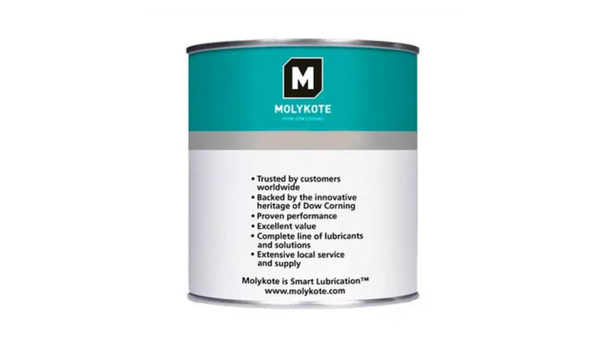
Main features
- 350 V/mil Dielectric Strength
- 2.0% Bleed at 204 deg C
- NLGI 2-3 Silicone/PTFE Grease
Product Description
MOLYKOTE® G-5008 Dielectric Grease is a yellow-green, NLGI 2–3 silicone grease containing PTFE solid lubricant for rubber-to-ceramic and rubber-to-rubber electrical interfaces, especially automotive spark-plug boots and electrical connectors. It is designed for precise automated dispensing and can also be applied by brush or grease gun. Typical electrical data include 350 V/mil dielectric strength at 50 mil, 1.02 × 10¹⁴ ohm-cm volume resistivity at 23°C and 123 seconds mean arc resistance. Condition-specific tests also report 2.0% bleed and 1.1% evaporation after 30 hours at 204°C, plus limited SRE-NBR-28/PX volume and hardness change. Confirm material compatibility, voltage, temperature, grease quantity and dispensing settings in the intended assembly.
Key features
- Silicone/PTFE dielectric grease: Light-consistency NLGI 2–3 formulation for electrically insulating rubber interfaces.
- Electrical properties: Typical dielectric strength of 350 V/mil at 50 mil, volume resistivity of 1.02 × 10¹⁴ ohm-cm at 23°C and 123 seconds mean arc resistance.
- High-temperature retention data: 2.0% bleed and 1.1% evaporation after 30 hours at 204°C.
- Rubber test results: SRE-NBR-28/PX volume change of +0.7% and hardness change of +1 Shore A under the stated tests.
- Low-temperature torque data: 361 gm-cm starting and 134 gm-cm running torque after 60 minutes at -20°C.
- Controlled application: Suitable for precise automated metering, brush application or grease-gun dispensing.
Applications / Suitable for
- Automotive spark-plug boots and rubber-to-ceramic interfaces
- Electrical connectors using rubber boots, seals or insulating interfaces
- Rubber-to-rubber electrical assemblies requiring dielectric, waterproof-seal and high-temperature evaluation
TDS, SDS & Technical Documents
Technical Specifications
No specifications available.
Additional Information
MOLYKOTE® G-5008 Dielectric Grease
A yellow-green, light-consistency silicone grease containing PTFE solid lubricant for rubber-to-ceramic and rubber-to-rubber electrical interfaces. Product-specific electrical, high-temperature retention, low-temperature torque, waterproof-seal and rubber-exposure data support evaluation for automotive spark-plug boots, electrical connectors and precisely metered assembly processes.

MOLYKOTE® G-5008 is a yellow-green silicone/PTFE dielectric grease for rubber electrical interfaces.
Grease composition, consistency and flow properties
Typical as-supplied data
| Property | Value | Unit | Method / condition |
|---|---|---|---|
| Color | Yellow-green | — | As supplied |
| NLGI consistency class | 2–3 | — | Supplier classification |
| Unworked penetration | 240–280 | mm/10 | ASTM D217 |
| Worked penetration | 251 | mm/10 | ASTM D1403; 60 strokes, 1/2 scale |
| Apparent viscosity | 52,000 | cSt | ASTM D445; -17°C |
| Dynamic viscosity | 5,000 | mPa·s | DIN 51810-1; CP25, 500 s⁻¹, 25°C |
Typical values are not specification limits. NLGI grade, penetration, apparent viscosity and dynamic viscosity describe different properties and should not be treated as interchangeable.
Electrical, thermal and service properties
The values below are typical, condition-specific laboratory results. Electrical values retain their stated specimen, voltage, temperature and frequency context; rubber-exposure and environmental results apply only to the listed materials and tests.
Electrical and thermal data
Dielectric strength, resistivity, dielectric constant and dissipation factor are different electrical properties and should not be treated as interchangeable.
| Property | Value | Unit | Method / condition |
|---|---|---|---|
| Dielectric strength | 350 | V/mil | ASTM D149 / AMS8660; 50 mil specimen |
| Volume resistivity | 1.02 × 10¹⁴ | ohm-cm | ASTM D257 / AMS8660; 23°C, 500 VDC |
| Volume resistivity | 9.60 × 10¹³ | ohm-cm | ASTM D257 / AMS8660; 177°C, 500 VDC |
| Arc resistance, mean | 123 | s | ASTM D495 / AMS8660 |
| Dielectric constant | 2.60 | — | ASTM D150 / AMS8660; 1 kHz |
| Dielectric constant | 2.70 | — | ASTM D150 / AMS8660; 1 MHz |
| Dielectric constant | 2.68 | — | ASTM D150 / AMS8660; 10 MHz |
| Dissipation factor | 0.0074 | — | ASTM D150 / AMS8660; 1 kHz |
| Dissipation factor | 0.0008 | — | ASTM D150 / AMS8660; 1 MHz |
| Dissipation factor | 0.0010 | — | ASTM D150 / AMS8660; 10 MHz |
| Thermal conductivity | 0.250 | W/mK | ASTM D5470; 30°C |
| Specific heat | 1.242 | J/(g·°C) | ASTM E2716; 50°C |
| Specific heat | 1.333 | J/(g·°C) | ASTM E2716; 100°C |
| Specific heat | 1.381 | J/(g·°C) | ASTM E2716; 150°C |
Retention, torque, material and environmental test results
Bench-test results do not establish universal equipment life, compatibility or sealing performance outside the stated conditions.
| Property | Value | Unit | Method / condition |
|---|---|---|---|
| Bleed | 2.0 | % | AMS8660; 30 h at 204°C |
| Evaporation | 1.1 | % | AMS8660; 30 h at 204°C |
| SRE-NBR-28/PX volume change | +0.7 | % | ASTM D471 / AMS8660 |
| Durometer hardness change | +1 | Shore A | ASTM D2240; initial hardness 80 Shore A |
| Low-temperature starting torque | 361 | gm-cm | ASTM D1478; -20°C |
| Low-temperature running torque | 134 | gm-cm | ASTM D1478; -20°C after 60 min |
| Flammability | Pass | Pass/Fail | AMS8660 |
| Corrosive effects on metals | Pass | No evidence | AMS8660 |
| Waterproof seal | Pass | Pass/Fail | AMS8660; 25°C for 24 h |
Typical values are not specification limits. Evaluate the grease in the intended electrical assembly, material combination, temperature, voltage and dispensing process before specification.
Meter and apply the grease to the intended interface
Select the dispensing method according to the assembly geometry, required grease quantity and production process. The product supports precise automated metering as well as conventional brush and grease-gun application.

Usable life is 60 months from the date of manufacture at ambient temperature in the original closed container. Keep containers properly labeled, use adequate ventilation, avoid strong oxidizing agents and review the current safety data and container label before handling.
Dielectric lubrication for rubber electrical interfaces
The documented uses center on rubber interfaces in electrical assemblies. Final suitability depends on the exact elastomer, ceramic or connector material, voltage, temperature, grease placement, assembly geometry and exposure conditions.


Evaluate MOLYKOTE® G-5008 for your electrical interface
Krayden can help review the connector or spark-plug-boot design, rubber and ceramic materials, dielectric requirements, operating temperature, grease location and quantity, automated dispensing parameters, and the product data most relevant to your qualification plan.


