
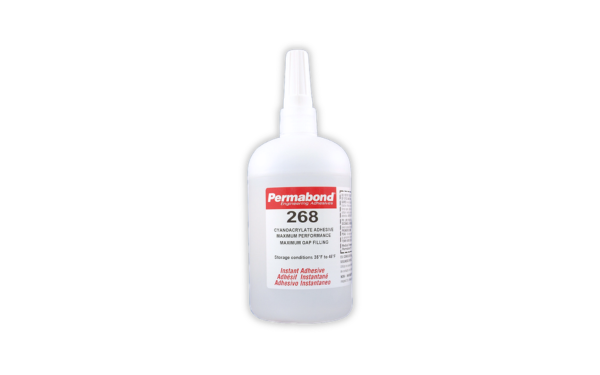
PERMABOND 268
Harmonization Code : 3506.10.00.00 | Prepared glues and other prepared adhesives, not elsewhere specified or included; products suitable for use as glues or adhesives, put up for retail sale as glues or adhesives, not exceeding a net weight of 1 kg
Main features
- 0.43 mm Maximum Gap Fill
- 5 to 10-Second Handling Time
- MIL-A-46050C Type II Class 3 Approval
Product Description
PERMABOND® 268 is a single-part, medium-high-viscosity ethyl cyanoacrylate adhesive developed for rapid bonding where greater gap-filling capability is required than with conventional low-viscosity instant adhesives. It bonds metals, ceramics, plastics and elastomers, including polyacetal and passivated metal surfaces. The adhesive requires no mixing, fixtures in approximately 5–10 seconds on selected tested substrates and reaches full strength after 24 hours. Its documented maximum gap fill is 0.43 mm.
Key features
- Medium-high viscosity: A typical viscosity of 1,200–2,400 mPa·s at 25°C supports controlled application and greater gap fill than lower-viscosity cyanoacrylates.
- Rapid fixture: Reaches the documented 0.3 N/mm² handling-strength threshold in approximately 5–10 seconds on steel, Buna-N rubber and phenolic.
- 0.43 mm maximum gap fill: Supports close-fitting assemblies with larger clearances than conventional instant adhesives.
- Broad substrate capability: Documented for metals, ceramics, plastics and elastomers, including polyacetal and passivated metals.
- Military specification approval: Approved to MIL-A-46050C Type II Class 3 for existing designs.
Suitable for
- Rapid assembly of metal, ceramic, plastic and elastomer components
- Joints requiring controlled application across gaps up to 0.43 mm
- Bonding polyacetal and passivated metal surfaces
Application videos
TDS, SDS & Technical Documents
Technical Specifications
General Properties
Physical Properties
Thermal Properties
Additional Information
PERMABOND® 268
PERMABOND® 268 is a single-part, medium-high-viscosity ethyl cyanoacrylate adhesive for rapid assembly where increased gap-filling capability is needed. It bonds metals, ceramics, plastics and elastomers and is specifically documented for polyacetal and passivated metal surfaces.

Medium-high-viscosity instant adhesive for rapid bonding and increased gap fill.
Uncured adhesive properties
The medium-high-viscosity formulation supports controlled placement and greater gap fill than conventional low-viscosity cyanoacrylates. Viscosity describes the uncured adhesive at 25°C and does not independently establish wetting or bond strength.
| Property | Typical value | Condition |
|---|---|---|
| Component | One | No mixing required |
| Chemical composition | Ethyl cyanoacrylate | - |
| Appearance | Colorless liquid | - |
| Viscosity | 1,200–2,400 mPa·s | 25°C |
| Specific gravity | 1.1 | - |
Values are typical guideline data and are not guaranteed product specifications.
Gap fill, fixture time and full strength
Fixture or handling time is defined as the time needed to reach 0.3 N/mm² shear strength. It must remain separate from the 24-hour period stated for full strength.
| Substrate | Typical fixture time | Definition |
|---|---|---|
| Steel | 5–10 seconds | Time to 0.3 N/mm² shear strength |
| Buna-N rubber | 5–10 seconds | Time to 0.3 N/mm² shear strength |
| Phenolic | 5–10 seconds | Time to 0.3 N/mm² shear strength |
Temperature, humidity, substrate chemistry and joint gap affect fixture time. Larger gaps and acidic surfaces may slow cure development.
Surface preparation and bonding process
PERMABOND 268 cures rapidly after assembly. Prepare and align the components before dispensing, apply the adhesive sparingly and avoid moving the joint while handling strength develops.
Recommended visual: substrate cleaning, optional metal abrasion, controlled dispensing, immediate alignment, joint pressure and fixture.
Large gaps or acidic surfaces
Larger gaps and acidic surfaces may reduce cure speed. Permabond C Surface Activator or Permabond QFS 16 may be evaluated where faster cure is needed.
Difficult or porous surfaces
A compatible Permabond activator may be considered for porous or difficult-to-bond surfaces, subject to application testing.
Low-surface-energy polymers
Polypropylene, polyethylene, PTFE and silicone require Permabond Polyolefin Primer before adhesive application.
Storage and handling
Store PERMABOND 268 at 2–7°C. Allow the closed bottle to reach room temperature before opening to reduce the risk of condensation entering the container and shortening shelf life. Use appropriate industrial hygiene practices and consult the current regional safety documentation before handling.
Substrate-specific shear strength
The following ISO 4587 values apply to the specified test substrates and conditions. Actual performance depends on substrate grade, preparation, joint gap, cure and test configuration.
| Substrate | Typical shear strength | Test context |
|---|---|---|
| Steel | 20–22 N/mm² (2,900–3,200 psi) | ISO 4587 |
| ABS | Greater than 6 N/mm² (>870 psi) | Substrate failure reported |
| PVC | Greater than 6 N/mm² (>870 psi) | Substrate failure reported |
| Polycarbonate | Greater than 5 N/mm² (>725 psi) | Substrate failure reported |
A substrate-failure result means the tested substrate failed before the adhesive joint under that particular test configuration. It is not a universal minimum bond-strength rating.
Mechanical and thermal properties
These values describe the cured adhesive or a specified laboratory test configuration. They do not independently establish complete bonded-assembly performance.
| Property | Typical value | Test Method |
|---|---|---|
| Impact strength | 3–5 kJ/m² (1.4-2.4 ft-lb/in²) | ASTM D950 |
| Coefficient of thermal expansion | 90 × 10−6 mm/mm/°C | - |
| Thermal conductivity | 0.1 W/(m·K) | - |
| Hardness | 85 Shore D | ISO 868 |
Temperature and environmental guidance
The cured adhesive may be exposed to approximately −55°C, depending on the bonded materials. It may tolerate higher temperatures briefly during operations such as paint baking or wave soldering when the joint is not heavily stressed.
PERMABOND 268 is not recommended for contact with strong oxidizing materials or polar solvents. Temperature and chemical resistance should be confirmed in the intended substrate system, joint geometry, exposure duration and load condition.
Rapid assembly with increased gap fill
PERMABOND 268 is relevant where fast fixture, controlled adhesive placement and accommodation of larger close-fitting joint gaps are important process considerations.

Metal and passivated-metal assembly
The adhesive is documented for metal bonding and can be used on passivated metal surfaces. Its medium-high viscosity supports controlled application where joint clearances are greater than those suited to very low-viscosity cyanoacrylates.

Polyacetal and engineering plastics
PERMABOND 268 is specifically identified for difficult-to-bond plastics such as polyacetal. Published test results also support evaluation on ABS, PVC and polycarbonate, subject to grade and surface-condition testing.

Elastomer and ceramic components
The product is documented for elastomers and ceramics. Fixture time and final bond performance remain dependent on formulation, surface condition, joint gap and actual assembly geometry.
Cyanoacrylate application and surface preparation
These videos provide complementary guidance. The first demonstrates the general sequence for applying and assembling cyanoacrylate-bonded parts, while the second explains surface preparation considerations that can affect bond consistency.
Cyanoacrylate directions for use
Learn the general sequence for dispensing a cyanoacrylate adhesive, aligning the components, applying pressure and allowing the joint to fixture without movement.
Surface preparation directions
Review cleaning, contamination removal and surface-conditioning steps that can influence adhesive wetting, cure and bonded-joint consistency.
Evaluate PERMABOND® 268 for your gap-filling rapid-assembly process
Contact Krayden to review joint clearance, substrate preparation, dispensing control, fixture-time requirements, activator or primer selection and application-specific testing for metal, plastic, ceramic or elastomer assemblies.


