
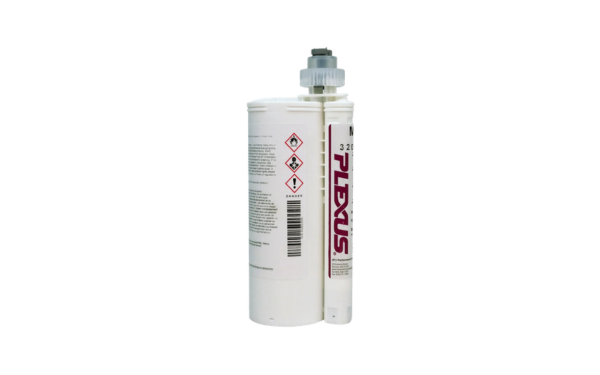
Plexus® MA1130 | Two-Part Methacrylate Adhesive
Harmonization Code : 3506.91.90.99 | Prepared glues and other prepared adhesives, not elsewhere specified or included; products suitable for use as glues or adhesives, put up for retail sale as glues or adhesives, not exceeding a net weight of 1 kg ; Adhesives based on polymers of headings 3901 to 3913 or on rubber; Other ; Other
Main features
- Two-part methacrylate for multi-material structural bonding
- 26–33 minute work time at 75°F
- Gap tolerance up to 0.5 inch
Product Description
Plexus® MA1130 is a two-part methacrylate structural adhesive for bonding composites and primed metals, with additional use on thermoplastic, metal, and composite assemblies. The 10:1 by-volume system provides a typical 26–33 minute working time at 75°F (23.9°C), 0.03–0.5 in (0.75–12.4 mm) gap tolerance, and a gray cured color. It can be dispensed from ready-to-use cartridges or bulk pails and drums. Limited surface preparation may be sufficient on supported substrates, while PC120 Cleaner Conditioner is recommended on metal.
Key features
- Multi-material structural bonding: Designed for composites and primed metals, with bonding use across thermoplastic, metal, and composite assemblies.
- Controlled processing window: 10:1 mix ratio by volume, typical 26–33 minute work time at 75°F (23.9°C), and 0.03–0.5 in (0.75–12.4 mm) gap tolerance.
- Cured mechanical profile: Typical tensile strength of 2,800–3,200 psi (19.3–22.1 MPa), 30–45% elongation at break, and Shore D 75 hardness.
Applications / Suitable for
- Structural bonding of composites and primed metals
- Thermoplastic, metal, and composite assemblies
TDS, SDS & Technical Documents
Technical Specifications
No specifications available.
Additional Information
Plexus® MA1130
Plexus® MA1130 is a two-part methacrylate structural adhesive for bonding composites and primed metals, with additional use on thermoplastic, metal, and composite assemblies. The 10:1 system combines an extended working window with substantial gap tolerance and cartridge or bulk dispensing options.
As-supplied properties
Typical component properties before mixing. Part A / Part B order is preserved where paired.
| Property | Value | Unit | Method / condition |
|---|---|---|---|
| Color | Off-white / Charcoal | – | Part A / Part B |
| Mix ratio by volume | 10:1 | A:B | Part A to Part B |
| Mix ratio by weight | 10.4:1.0 | A:B | Part A to Part B |
| Component density | 0.98 / 0.95 | g/mL | Part A / Part B |
| Component viscosity | 110–150 / 90–130 | ×10³ cP | Part A / Part B |
Processing and application
MA1130 can be dispensed from handheld cartridges or automatic meter/mix/dispense equipment. Bonding performance depends on maintaining the specified component ratio, controlling adhesive temperature, preparing contaminated surfaces appropriately, and mating the parts within the working time.
Recommended bonding sequence
Shelf life is 6 months based on continuous storage between 55°F and 77°F (13°C and 25°C). Intermittent or prolonged exposure above 80°F (27°C) reduces shelf life, and exposure above 100°F (38°C) should be avoided. Cool storage between 45°F and 65°F (7°C and 18°C) may extend shelf life; return cold-stored material to room temperature before use. Mixing large masses can generate substantial exothermic heat, so dispense only the quantity that can be used within the working time and keep gap thickness within the product’s maximum gap-fill capability.
Typical cured properties
Typical cured material properties. Tensile properties are in accordance with ASTM D638 / ISO 527.
| Property | Value | Unit | Method / condition |
|---|---|---|---|
| Final color | Gray | – | Cured adhesive |
| Gap tolerance | 0.03–0.5 | in | 0.75–12.4 mm; gap tolerance, not a universal recommended bondline thickness |
| Hardness | 75 | Shore D | Typical cured property |
| Tensile strength | 2,800–3,200 | psi | 19.3–22.1 MPa; ASTM D638 / ISO 527 |
| Tensile modulus | 95–110 | kpsi | 655–758 MPa; ASTM D638 / ISO 527 |
| Elongation at break | 30–45 | % | ASTM D638 / ISO 527 |
| Peak exotherm time | 60–80 | min | 10 g sample |
| Peak exotherm temperature | 260 (127) | °F (°C) | 10 g sample |
Typical lap shear performance
Typical lap shear values measured according to ASTM D1002. CF indicates cohesive failure. PC120 Cleaner Conditioner is recommended on metal.
| Property | Value | Unit | Method / condition |
|---|---|---|---|
| Lap shear, aluminum | 2,350 (16.2) | psi (MPa) | ASTM D1002; cohesive failure |
| Lap shear, primed steel | 2,716 (18.7) | psi (MPa) | ASTM D1002; cohesive failure |
Technical guidance
Evaluate Plexus® MA1130 for your assembly
Need to validate MA1130 for a specific substrate pair, bond gap, dispense method, or temperature profile? Krayden can help review joint requirements, surface preparation, processing conditions, and the product’s typical strength data before application testing.


