
STYCAST 2741LV
Harmonization Code : 3910.00.00.90 | Silicones in Primary Forms; Others
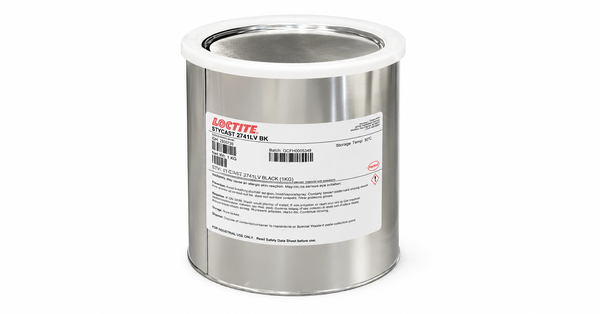
Main features
- Lower-Viscosity Electronic Potting
- Selectable Rigid-to-Flexible Cure
- Impact-Resistant Multi-Substrate Encapsulation
Product Description
LOCTITE STYCAST 2741LV Epoxy Encapsulant is a lower-viscosity, black filled epoxy system used with Catalyst 15 LV for electronic embedment, sealing, and cementing of glass, metals, plastics, and ceramics. Changing the catalyst amount produces rigid, semi-rigid, or flexible cured states, while typical mixed viscosity ranges from 16,000 to 30,000 mPa s. Work life is 90 to 120 minutes at 25 deg C, followed by room-temperature or accelerated cure. The cured formulations provide distinct hardness and strength levels with shock and impact resistance for assemblies requiring adjustable mechanical response.
Key features
- Lower-viscosity processing: Mixed viscosity ranges from 16,000 to 30,000 mPa s across the three formulations.
- Selectable cured response: Catalyst 15 LV loading produces rigid, semi-rigid, or flexible material.
- Shock and impact resistance: The product is positioned for assemblies requiring shock or impact resistance.
Applications
Applications include electronic embedment and sealing or cementing of metals, ceramics, and plastics where lower viscosity and adjustable flexibility are useful.
TDS, SDS & Technical Documents
Technical Specifications
General Properties
Additional Information
As-supplied / before-processing properties
Typical values for STYCAST 2741 LV with Catalyst 15 LV; formulation ratios determine rigid, semi-rigid, or flexible behavior.
| Property | Value | Unit | Method / condition |
|---|---|---|---|
| Resin density | 1.58 | g/cm^3 | TP-13 |
| Resin viscosity | 35,000 | mPa s (cP) | TP-10 or TP-11 |
| Catalyst density | 0.97 | g/cm^3 | TP-13 |
| Catalyst viscosity | 11,000 | mPa s (cP) | TP-10 or TP-11 |
| Mixed viscosity | 30,000 / 25,000 / 16,000 | mPa s (cP) | Rigid / semi-rigid / flexible formulations |
| Work life | 120 / 90 / 90 | minutes | 100 g at 25 deg C; rigid / semi-rigid / flexible |
| Cure schedule | 16 to 24 h at 25 deg C; 4 to 6 h at 45 deg C; 2 to 4 h at 65 deg C; 30 to 60 min at 90 deg C | Typical alternatives |
After-processing / final-state properties
Typical after-application properties vary with the rigid, semi-rigid, or flexible formulation.
| Property | Value | Unit | Method / condition |
|---|---|---|---|
| Hardness | 82 Shore D / 74 Shore D / 50 Shore D | Rigid / semi-rigid / flexible; TP-311 | |
| Compressive strength | 98 / 69 / 35 | N/mm^2 | Rigid / semi-rigid / flexible; TP-207 |
| Tensile strength | 48 / 44 / 4 | N/mm^2 | Rigid / semi-rigid / flexible; TP-239 |
| Glass transition temperature | 68 / 38 / 21 | deg C | Rigid / semi-rigid / flexible; DSC/TMA |
| Operating temperature range | -40 to 90 / -55 to 80 / -55 to 65 | deg C | Rigid / semi-rigid / flexible |
| Dielectric strength | 16 | kV/mm | All three formulations; TP-297 |
| Volume resistivity | >1 x 10^15 / >1 x 10^15 / >1 x 10^14 | ohm cm | Rigid / semi-rigid / flexible at 25 deg C; TP-183 |
| Linear shrinkage | 0.001 | cm/cm | All three formulations; TP-320 |


