
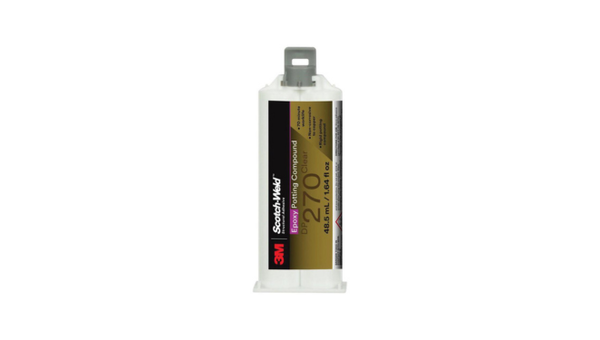
3M DP270
Harmonization Code : 3506.91.90.99 | Prepared glues and other prepared adhesives, not elsewhere specified or included; products suitable for use as glues or adhesives, put up for retail sale as glues or adhesives, not exceeding a net weight of 1 kg ; Adhesives based on polymers of headings 3901 to 3913 or on rubber; Other ; Other
Main features
- Low-Viscosity Electronic Potting
- 70-Minute Working Window
- Low-Shrinkage Rigid Encapsulation
Product Description
3M™ Scotch-Weld™ Epoxy Potting Compound/Adhesive DP270 is a rigid, two-part, low-viscosity epoxy formulated for potting, sealing, encapsulating and bonding electronic and electrical components. It combines a 1:1 mix ratio by volume with a 70-minute work life, minimal exotherm and low shrinkage. The product is non-corrosive to copper and provides electrical insulation, thermal-shock resistance and room-temperature cure. DP270 is available in Black and Clear formulations for different appearance and performance requirements.
Key features
- Low-viscosity epoxy system: Supports controlled dispensing into electronic assemblies and potting cavities.
- 70-minute work life: Provides time for dispensing, component positioning and assembly before cure progresses.
- Minimal exotherm and low shrinkage: Supports potting and encapsulation of electronic components where cure-generated heat and dimensional change are important.
- Electrical insulation: Provides high volume resistivity and documented dielectric properties in the cured state.
- Black and Clear options: Allows selection based on appearance, handling-strength time and documented cured-property differences.
Suitable for
- Potting and encapsulating electronic and electrical components
- Sealing electronic assemblies and component housings
- Bonding metals, FR-4, fiber-reinforced plastics and selected thermoplastics
Technical Specifications
General Properties
Physical Properties
Thermal Properties
Mechanical Properties
Electrical Properties
Additional Information
3M™ Scotch-Weld™ Epoxy Potting Compound/Adhesive DP270
3M™ Scotch-Weld™ DP270 is a rigid, two-part, low-viscosity epoxy system designed primarily for potting, sealing and encapsulating electronic components. Its 70-minute work life, minimal exotherm, low shrinkage and documented electrical properties support controlled processing in electronic and electrical assemblies. Black and Clear formulations are available.

Two-part epoxy potting compound available in Black and Clear formulations.
Key processing properties
DP270 uses an epoxy base and amine accelerator supplied at a 1:1 mix ratio by volume. The Black and Clear variants share the same nominal working time but differ in component density, mix ratio by weight and handling-strength time.
| Property | DP270 Black | DP270 Clear | Condition or context |
|---|---|---|---|
| Mix ratio by weight, B:A | 1:1.06 | 1:0.87 | Bulk mixing |
| Base viscosity | 11,000 mPa·s | 12,000 mPa·s | Typical at 23°C |
| Accelerator viscosity | 12,000 mPa·s | 11,000 mPa·s | Typical at 23°C |
| Work life | 70 minutes | 70 minutes | Typical at 23°C |
| Time to handling strength | 6 hours | 5 hours | Typical at 23°C; minimum 0.3 MPa overlap shear strength |
| Time to full cure | 24 hours | 24 hours | Typical at 23°C |
Values are representative or typical laboratory data and are not product specifications. Working and cure times depend on adhesive temperature, mixed quantity and assembly conditions.
Mixing, application and cure
DP270 may be dispensed from Duo-Pak cartridges with compatible 3M™ EPX™ equipment or mixed from bulk containers. Accurate proportioning and thorough mixing are required before dispensing, potting or bonding.
Recommended visual: surface preparation, metering, mixing, controlled dispensing, component potting and room-temperature or accelerated cure.
Storage and handling
Store DP270 according to the temperature and shelf-life requirements stated on the product packaging and current manufacturer documentation. Keep components sealed when not in use and prevent contamination during cartridge or bulk dispensing. Review the applicable safety documentation before handling either component.
DP270 Black and Clear comparison
Both formulations use a 1:1 mix ratio by volume and provide a 70-minute work life. Select the variant according to appearance, handling requirements and application-specific mechanical or electrical performance.
| Selection factor | DP270 Black | DP270 Clear |
|---|---|---|
| Cured appearance | Black, opaque | Clear, transparent amber appearance |
| Handling strength at 23°C | 6 hours | 5 hours |
| Shore D hardness | 80 | 72 |
| Glass-transition temperature | 38°C | 47°C |
| CTE below Tg | 76.8 × 10⁻⁶ m/m/°C | 89.5 × 10⁻⁶ m/m/°C |
| CTE above Tg | 189.3 × 10⁻⁶ m/m/°C | 197.3 × 10⁻⁶ m/m/°C |
| Dielectric constant at 1 kHz | 3.87 | 3.51 |
| Dissipation factor at 1 kHz | 0.0095 | 0.0163 |
| Volume resistivity | 2.37 × 10¹⁵ Ω·cm | 8.04 × 10¹⁴ Ω·cm |
| Thermal conductivity | 0.311 W/(m·K) at 110°F | Not reported in the supplied Clear TDS |
| Elongation | 4.2% | 13.9% |
| Additional Clear property | Not reported | Refractive index 1.575 at 532 nm and 23°C |
Strength values are substrate-, preparation-, bondline- and test-specific. They should not be treated as universal bond-strength ratings or direct proof of performance in another assembly.
Electrical, mechanical and environmental performance
DP270 provides electrical insulation together with documented adhesion and thermal-shock performance. Cured-property and bonded-joint results remain dependent on the selected formulation, substrate, surface preparation, cure, bondline and test conditions.
| Substrate | Surface preparation | DP270 Black | DP270 Clear |
|---|---|---|---|
| Sandblasted aluminum | Sandblasted | 16.4 MPa | 5.5 MPa |
| Copper | Solvent wipe | 9.7 MPa | 5.2 MPa |
| FR-4 | Solvent wipe | 15.3 MPa | 14.3 MPa |
| Epoxy FRP | IPA wipe, abrasion and IPA wipe | 14.1 MPa | 15.8 MPa |
| PVC | Solvent wipe | 2.0 MPa | 2.4 MPa |
Overlap shear results used ASTM D1002 or ISO 4587 and a documented 0.07–0.25 mm bondline. Values apply only to the stated formulation, substrate, preparation, specimen geometry, cure and test conditions.
Electronic potting, encapsulation and bonding
DP270 is intended primarily for potting and bonding electrical and electronic components. The formulation supports assemblies requiring low-viscosity dispensing, electrical insulation and controlled room-temperature curing.
Electronic component potting
The low-viscosity system can be dispensed around components and into housings or cavities where the cured epoxy provides electrical insulation and rigid support.
Sealing and encapsulation
Minimal exotherm and low shrinkage make DP270 relevant for encapsulating electronic parts where excessive cure heat or dimensional change may be undesirable.
Electronic assembly bonding
Documented adhesion data support evaluation on FR-4, copper, aluminum, fiber-reinforced plastics and selected thermoplastics after appropriate surface preparation.
Evaluate 3M™ Scotch-Weld™ DP270 for your electronic assembly
Contact Krayden to compare DP270 Black and Clear, review substrate preparation, select suitable dispensing equipment and evaluate working time, cure conditions, bondline design and environmental requirements for your potting, encapsulation or bonding process.


